Trānsitus
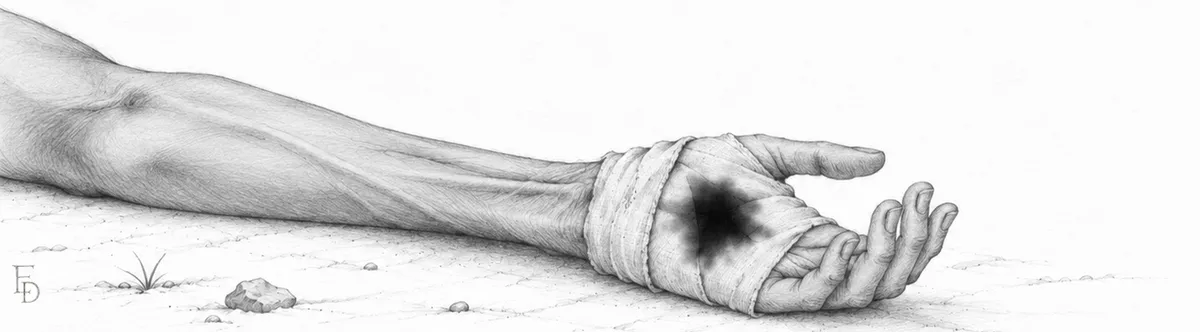 Illustrated by the author.
© Edmond Dantès. All rights reserved.
Illustrated by the author.
© Edmond Dantès. All rights reserved.
As he was wasted away by that grievous sickness which put an end to all his sufferings, he caused himself to be laid naked upon the naked ground, that in that last hour, wherein the enemy might still rage against him, he might wrestle naked with the naked. The fearless man awaited the triumph, and, joining his hands, held the crown of righteousness.
Laid upon the ground and stripped of his haircloth garment, he raised his face, as was his wont, toward heaven; and, wholly intent upon that glory, he covered with his left hand the wound in his right side, that no one might see it.
Then he said to the brethren: “I have done what was mine to do; may Christ teach you what is yours.”1
— Thomas of Celano, Second Life, §214
Today is the 800th death anniversary of the Saint I love the most, Francesco di Bernardone (Francis of Assisi). Joyeux anniversaire au paradis, Frère François!
What is a “heavenly birthday”? Every so often, Facebook serves up the same phrase: Happy heavenly birthday, Mom. Happy heavenly birthday, Dad. Celebrating his first birthday in heaven. I understand the sentiment. Someone we love has died; their birthday returns; we miss them; and ordinary language feels inadequate.
But as “Christian” language, “heavenly birthday” can become muddled very quickly, because Christianity already possesses an ancient and quite precise idea of a heavenly birthday—and it does not mean the earthly birthday of someone who happens to be dead.
The traditional expression is the Latin dies nātālis, literally “day of birth.” In early Christianity, particularly in the commemoration of martyrs, the phrase came to designate the day of death. A martyr’s death was his dies nātālis because that was the day on which he passed from this life into the life of the world to come.
The Church of Smyrna was already commemorating the martyrdom of Saint Polycarp in the second century in precisely this fashion, gathering annually at the place where his remains had been deposited. Over time, the anniversary of a saint’s death normally became the saint’s feast day.2 The paradox was deliberate: what the world called death, Christians dared to call birth.
That is why the traditional Christian calendar generally commemorates saints not on the dates when their mothers gave birth to them, but on the dates when they died. The day of a martyr’s death was called his natale or dies nātālis because it was regarded as his entrance into “a new and better world.”3
The exceptions are conspicuous precisely because they are exceptions. The Church celebrates the earthly births of the Lord Jesus, the Virgin Mary, and John the Baptist. For most other saints, the liturgical anniversary is associated instead with death: their passage from the earthly Church to the Church Triumphant.
So if we want to use the phrase “heavenly birthday” in a genuinely traditional Christian sense, then (for example) the heavenly birthday of Saint Francis is 3 October 1226—not whatever day in 1181 or 1182 he was born in Assisi. 3 October is his dies nātālis. Calling his earthly birthday his “heavenly birthday” after his death would reverse the meaning of the expression.
There is another problem with the way the phrase is casually used, and this one is theological rather than merely linguistic. “Happy heavenly birthday” often carries an unspoken presumption: this person is now in heaven. Christians certainly may hope for that. We should hope for it. We should pray for it.
But Catholicism traditionally distinguishes hope for the salvation of the deceased from certainty that a particular deceased person has already attained heaven or the beatific vision.
The entire practice of praying for the dead depends upon that distinction. Purgatory exists precisely because those who die in friendship with God may nevertheless require purification before entering the full vision of God.4 To pray for the dead while simultaneously speaking as though we know they are already enjoying heaven rather empties the prayer of some of its seriousness.
But there is an important correction to make here. It would be wrong to say that only canonized saints go directly to heaven and everyone else goes through Purgatory. Catholic teaching does not say that.
A person who dies in God’s grace and is already perfectly purified may enter heaven without further purification. Nor does canonization necessarily mean that the person experienced no purification after death. What canonization establishes is that the person is now in heaven and may be publicly venerated by the Church; it does not ordinarily pronounce upon whether that person passed through some purification between death and the beatific vision.5 The saints known to the Church are not necessarily the only saints in heaven. They are the ones whose heavenly glory the Church has formally recognized.
That distinction actually makes the older Christian language more beautiful, not less. Dies nātālis is not sentimental shorthand for “the dead person’s birthday, except now we imagine the cake is in heaven.” It expresses something much more radical. Death itself becomes a birth. The calendar date that matters is transformed because the Christian has crossed the boundary between this life and eternity.
When the Church commemorates a saint’s dies nātālis, she is not wistfully relocating an earthly birthday party to the clouds. She is commemorating a death that faith understands as entrance into everlasting life.
And that is why I wince whenever I see Happy heavenly birthday attached to the earthly birthday of someone who has died. The intention is affectionate, and I would never begrudge anyone grief or the language by which grief survives. But the phrase is doing theological work whether we intend it or not. It confuses an earthly birthday with the ancient Christian dies nātālis, and sometimes it speaks with presumption about someone’s immediate heavenly destiny that the Christian tradition itself treats more carefully and sensitively.
By all means, let us remember the birthdays of the people we loved and still love. Say, Today would have been Dad’s eighty-fifth birthday. Remember the cake, the terrible jokes, the old photographs, the things he used to say. Pray for him. Give thanks for his life. Miss him.
But his birthday remains his birthday. His dies nātālis—his “heavenly birthday”—is the day he died.
1. Thomas of Celano, The Lives of S. Francis of Assisi, trans. A. G. Ferrers Howell (London: Methuen & Co., 1908), 342–343.
2. Peter Brown, The Cult of the Saints: Its Rise and Function in Latin Christianity (Chicago: University of Chicago Press, 1981), 3–22.
3. John Dowden, The Church Year and Kalendar (Cambridge: Cambridge University Press, 1910), 13–14.
4. Joseph Ratzinger, Eschatology: Death and Eternal Life, 2nd ed., trans. Michael Waldstein (Washington, DC: Catholic University of America Press, 1988), 218–233.
5. Ludwig Ott, Fundamentals of Catholic Dogma, trans. Patrick Lynch, ed. James Canon Bastible (St. Louis: B. Herder Book Company, 1954), 474–485.