Same old, same old
Even if most people have never heard of Dutch artist Johannes Vermeer (1632–1675), chances are they have seen his Girl with a Pearl Earring, one of the most recognizable paintings in Western art . . .
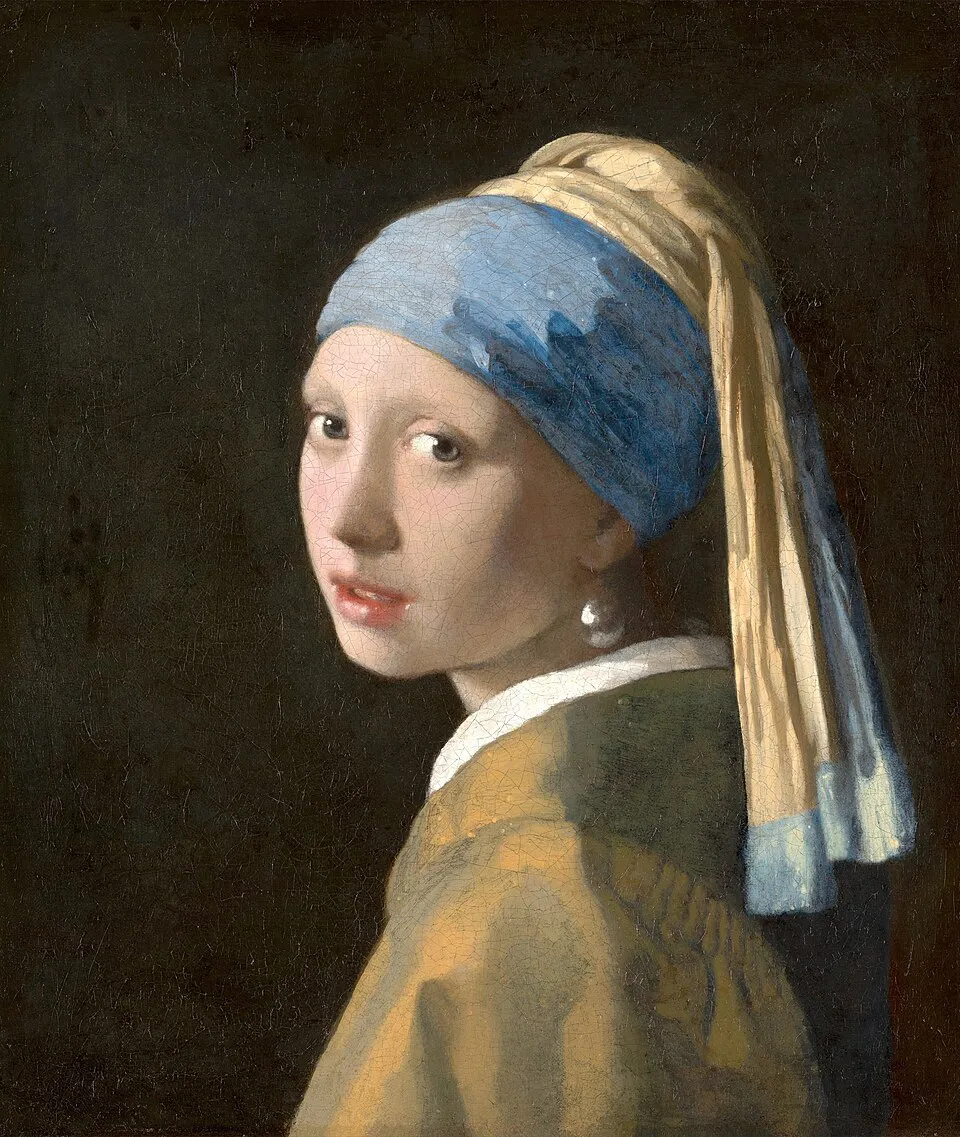 Mauritshuis, The Hague.
What has always fascinated me about Vermeer is the striking similarity in the backgrounds of his interior paintings. Although the figures, their clothing, and their activities differ from one canvas to another, the settings feel nearly—and eerily—identical. This consistency intrigues me endlessly: did Vermeer paint most of these scenes in the same room, simply rearranging the furniture, altering the decor, and introducing new figures as each composition required?1
In The Music Lesson, a woman stands at a virginal with her back to the viewer, while a gentleman watches attentively beside her beneath a large mirror that reflects part of the room and offers an unexpected glimpse of her face . . .
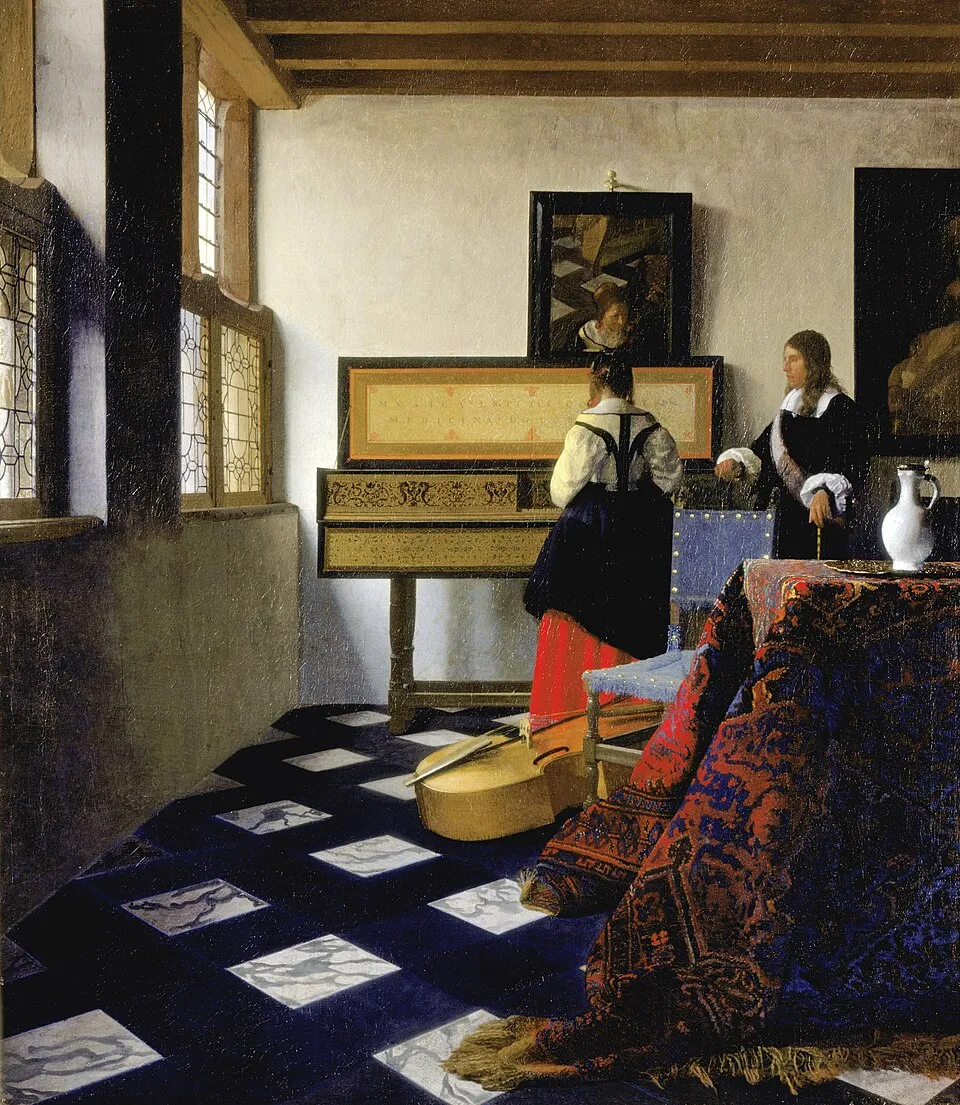 Royal Collection, United Kingdom.
The solitary figure in Woman Holding a Balance contemplates as she delicately balances a small scale between her fingers, set against the backdrop of a painting of the Last Judgment . . .
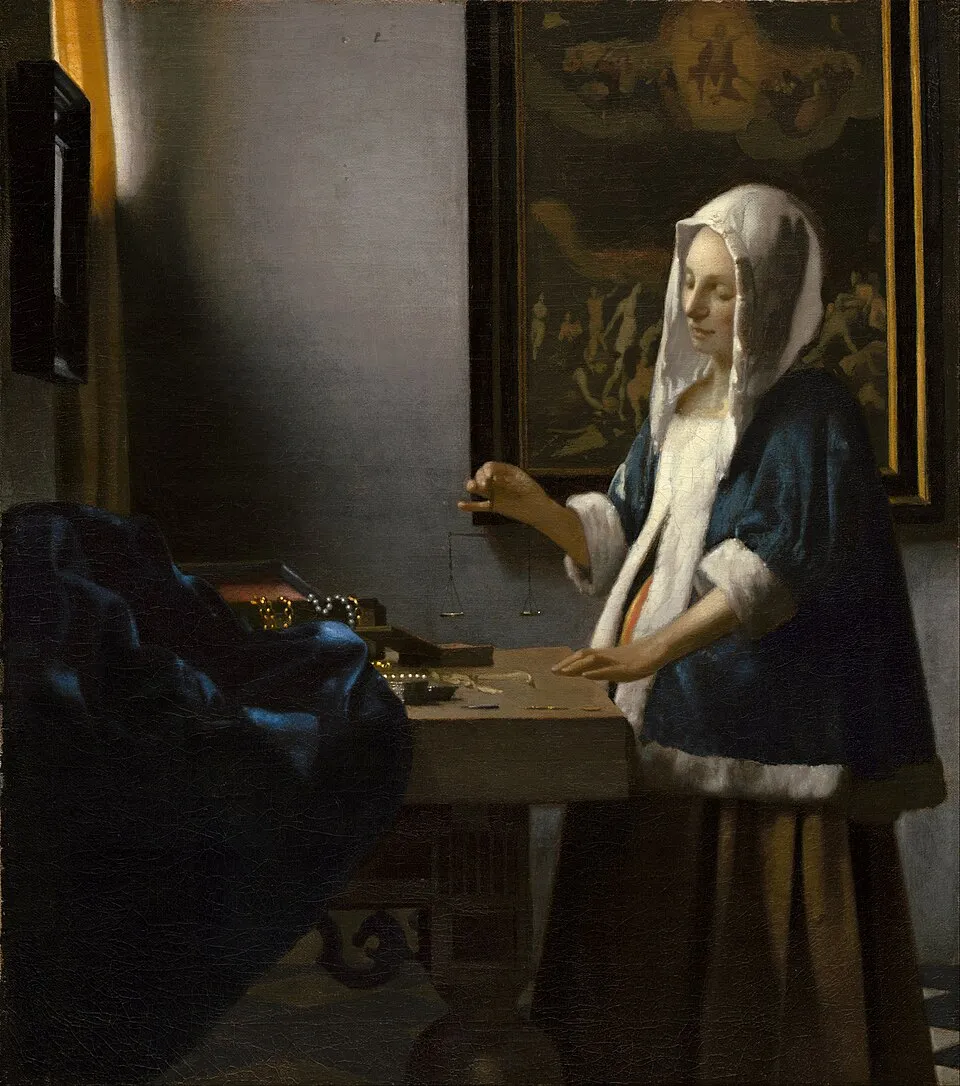 National Gallery of Art, Washington, D.C.
In Young Woman with a Water Jug, daylight illuminates the subject in a blue bodice and white linen headdress as she opens a window, her other hand resting on a silver vessel in a basin . . .
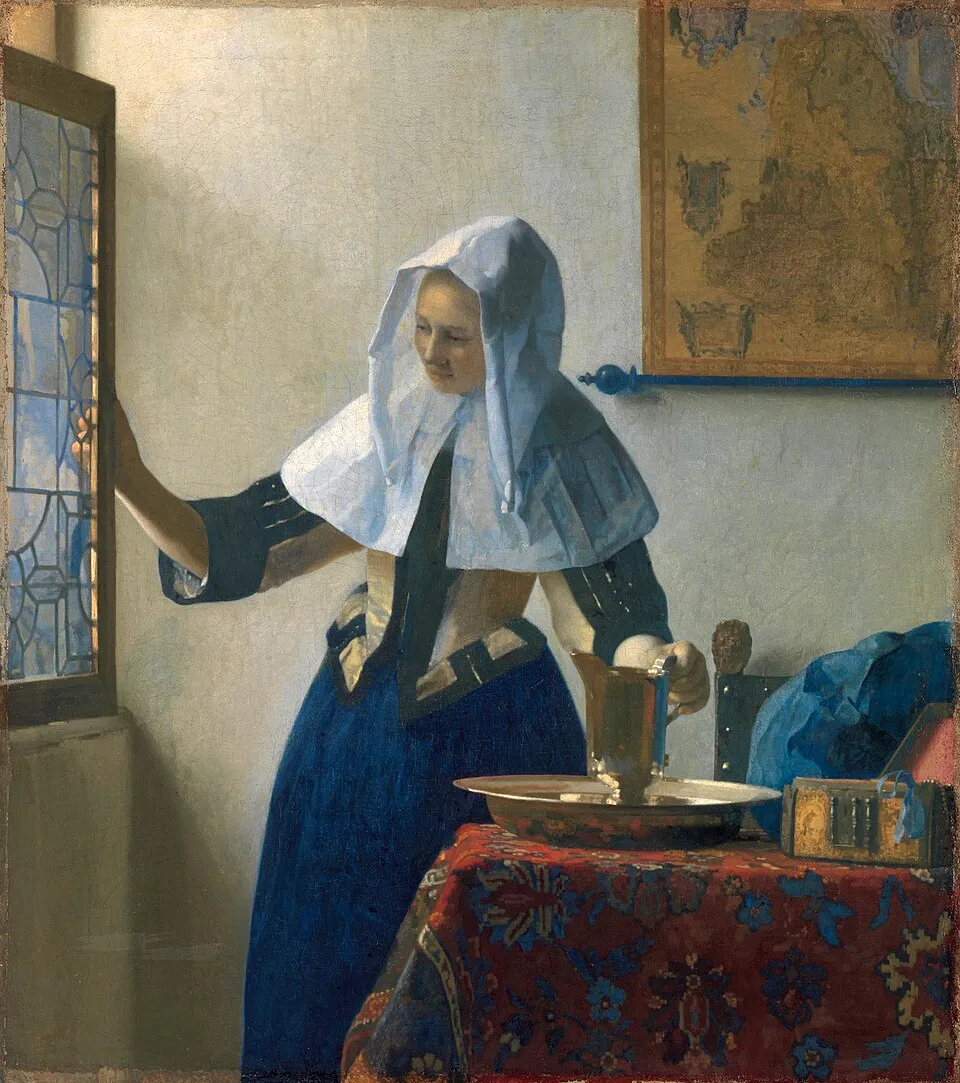 Metropolitan Museum of Art, New York.
Finally, the central figure in Woman with a Lute, sits by a window, her gaze drawn toward something beyond the frame, surrounded by a large wall map, an empty chair, and scattered sheet music . . .
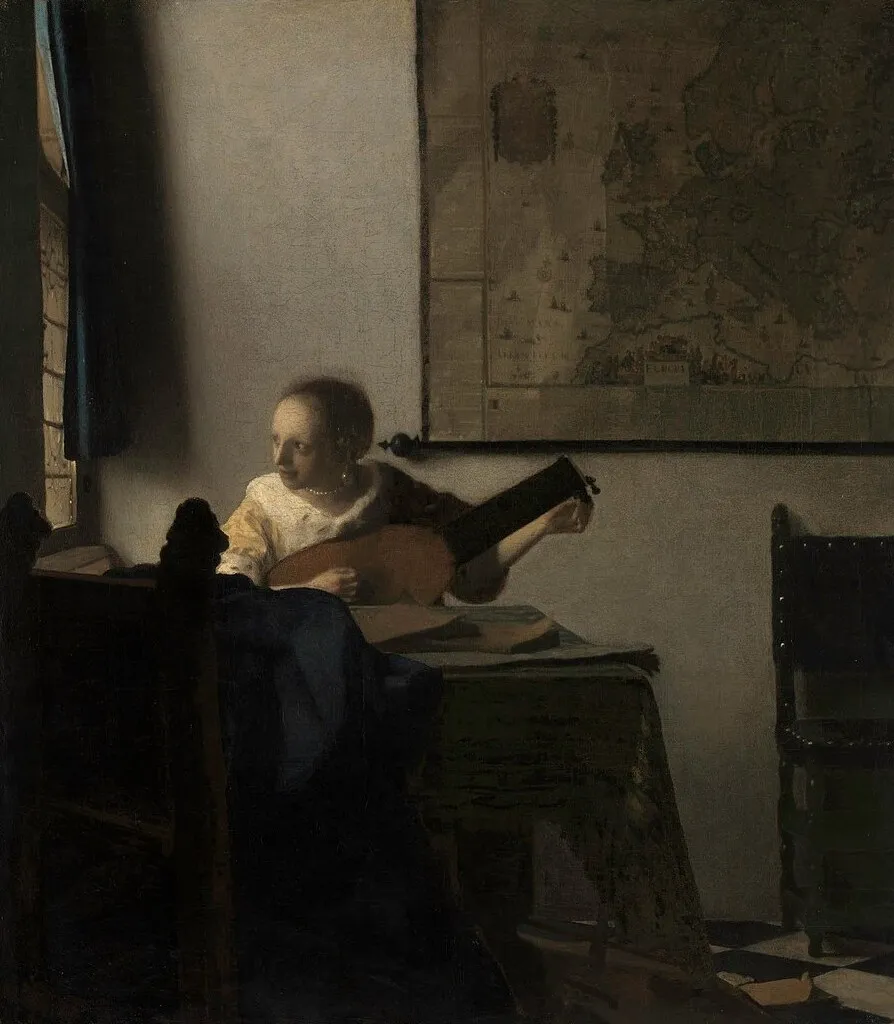 Metropolitan Museum of Art, New York.
A closer look at these paintings reveals structural similarities that are impossible to ignore. In painting after painting, Vermeer positions his figures near tall, leaded-glass windows typical of 17th-century Dutch homes. These windows, whether open, closed, or partially cropped, consistently channel light from the upper left, casting brilliant illumination on faces, garments, and objects while leaving other corners in soft shadow.
Equally striking is the repetition of specific objects. Distinctive heavy chairs with carved lion-head finials, carpet-covered tables, wall maps, flowing curtains, musical instruments, and even paintings within his paintings appear across multiple compositions. They are not static copies; a chair dominating the foreground of one work might be pushed against a wall in another, or a broad map might replace a quieter painting as the central wall decoration. It seems as though Vermeer possessed a modest inventory of household items that he continually reassembled to serve his artistic needs.2
Of course, Vermeer was not merely cataloging his furniture. His interiors are masterfully engineered compositions where every object serves a calculated aesthetic purpose. The placement of a chair, the angle of a table, or the dramatic fold of a curtain directly alters the balance of the entire scene.3 Capable of modifying room proportions or omitting distracting architectural details, Vermeer transformed what appears to be a literal record of an actual room into a carefully orchestrated artistic invention.
There is, nevertheless, strong evidence that Vermeer drew directly from his own living space. He spent much of his career in Delft, a city in the Netherlands, where he lived with his wife and children in the house of his mother-in-law on a street called the Oude Langendijk. A post-mortem inventory from 1676 records the household contents and confirms an upstairs studio space.4 Scholars have long analyzed floor patterns, tile geometry, and light angles to reconstruct the studio layout and pinpoint Vermeer’s working position. While variations in window design, ceiling beams, and room proportions lead some experts to argue that he worked across multiple rooms or freely altered architectural elements,5 the persistent architectural signatures suggest he continually returned to a select few physical spaces.
Ultimately, whether all these paintings were executed in a single room is less important than the extraordinary creative variety Vermeer extracted from such limited surroundings. Vermeer transformed the same familiar window, table, and chair into entirely different emotional environments.6
There is something deeply compelling about imagining Vermeer returning to the same room day after day, looking at the same walls and windows, yet discovering endless aesthetic possibilities within them. He did not require grand architecture, sweeping landscapes, or extraordinary settings to create masterpiece after masterpiece. A few domestic rooms, ordinary furniture, the people around him, and incoming daylight were enough to fuel his imagination for years—demonstrating the profound scope of artistic invention possible within the confines of a single Dutch household.
Now come to think of it. You may have noticed something similar in the photographs I post on this blog. Although the objects or things change from one photograph to another, the backgrounds are suspiciously familiar. Almost everything is photographed on one of the same few surfaces in the parish house: the kitchen counter, either of the two dining tables, or the stove.
Like Vermeer, I simply rearrange things, change the composition, and occasionally experiment with the lighting. The difference, of course, is that Vermeer turned his domestic surroundings into some of the greatest masterpieces in the history of art, while I use mine to photograph whatever happens to catch my fancy.
But at least we have one thing in common: neither of us seems particularly interested in finding a new studio.
1. Philip Steadman, Vermeer’s Camera: Uncovering the Truth Behind the Masterpieces (Oxford: University Press, 2001), 73–74.
2. James A. Welu, “Vermeer: His Cartographic Sources,” The Art Bulletin 57, no. 4 (December 1975): 529–30.
3. Gregor J. M. Weber, “Vermeer’s Use of the Picture-within-a-Picture: A New Approach,” Studies in the History of Art 55 (1998): 294–95.
4. John Michael Montias, Vermeer and His Milieu: A Web of Social History (Princeton, NJ: University Press, 1989), 220–21.
5. Benjamin Binstock, Vermeer’s Family Secrets: Genius, Discovery, and the Unknown Apprentice (New York: Routledge, 2009), 15–16.
6. E. Melanie Gifford, “Painting Light: Recent Observations on Vermeer’s Technique,” Studies in the History of Art 55 (1998): 185.