Pier Giorgio in Love
A Love Story of Saint Pier Giorgio Frassati
by EDMOND
DANTÈS
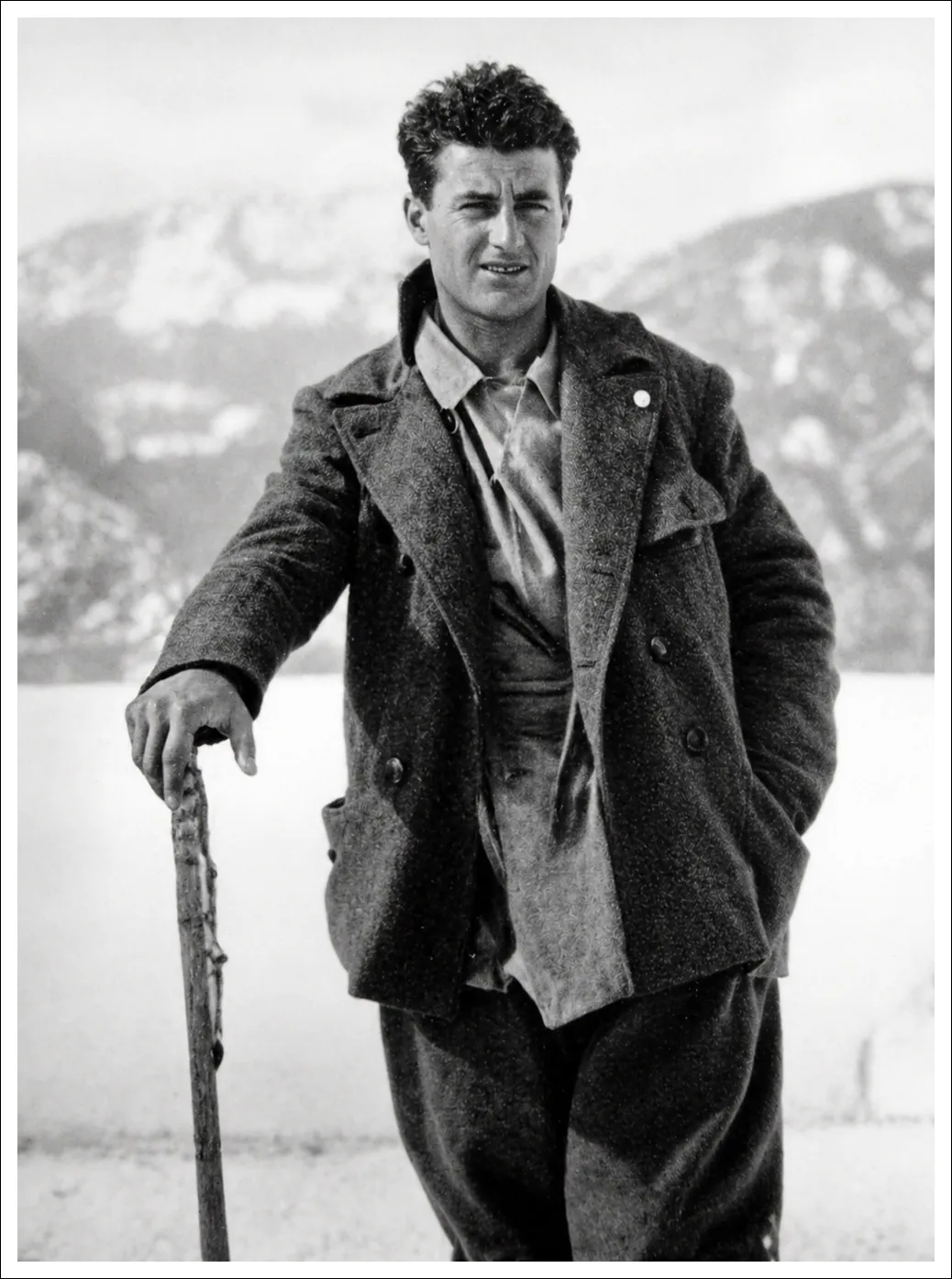 © OSV News/Catholic Press Photo. All rights reserved.
The wind of the Alps moved rapidly across the ridge, carrying cold, dry air. As Pier Giorgio planted his alpenstock into the snow crust, his lungs registered a sharp, intense sensation with each inhalation. Below him, partially obscured by a dense layer of winter smog, Turin remained still with reduced visibility. While Blackshirts marched on the cobblestones, suppressing dissent through brute force with truncheons, the air at this elevation was neither controlled nor regulated by any regime.
He turned and reached down the steep incline. Laura Hidalgo was thigh-deep in the powder, her breath coming in irregular, forceful exhalations, while her dark hair escaped her wool cap in loose, uncontained strands. Their leather gloves met. He hauled her over the crest, and for a moment, perched where the atmosphere grows sparse, they collapsed against each other, their faces flushing with the high-altitude glow of the summit won.
He was a striking figure against the overcast sky—unusually tall, possessing the broad, muscular shoulders of an oarsman and the efficient, controlled movements of an experienced climber. When he looked at her, the sharp, incandescent light of his gaze, which was usually so fixed and piercing, dissolved into a perilous softness. The wide, boyish smile that made him so beloved in the university halls formed across his handsome face, creating a radiant flash of warmth against the biting cold of the heights.
She pulled away first, looking down at the gray smudge of the city.
“Your father’s paper,” she said, her voice jagged from exertion during the climb, “printed a review of the opera today. There was nothing about the arrests in the piazza.”
Pier Giorgio struck a match, shielding it with his large hands to light his pipe, though the tobacco smoke dispersed immediately in the strong wind. “The censor’s pen is heavy, Laura. My father fights in a language of nuance you refuse to learn.”
“And what is your language? The clink of soup coins in a beggar’s tin?” She turned to him, her eyes unblinking and challenging. “Charity is a bandage, Pier Giorgio. It is not a cure.”
“We serve the wound that is bleeding right now,” he replied quietly.
A stray snowflake rested on her dark eyelashes.
Consequently, he felt a sudden, strong, and urgent desire to reach out and brush it away—a simple, human impulse that felt intensely intimate and difficult to control. Instead, he forced his hand deep into his wool coat, allowing his fingers to find the worn, wooden beads of his Rosary, and used the tactile contact to steady his thoughts and behavior.
▪ ▪ ▪
The descent back to the Frassati apartment on Corso Oporto involved a return to an environment characterized by increased confinement and reduced freedom of the body. Constructed with mahogany paneling and enclosed proportions, the dining room held air that contained the combined scents of beeswax and roasted meats, yet no conversation occurred.
Alfredo Frassati sat at the head of the long table, maintaining a rigid, controlled posture while looking at the rim of his crystal wine glass. At the opposite end, Adélaïde sat perfectly rigid, her spine held in a straight, upright position without making contact with the back of her chair. The only sound was the precise, controlled contact of silver forks against porcelain.
Sitting between them, Pier Giorgio’s imposing, athletic frame was disproportionate to the scale and design of the delicate, antique furniture. His wide chest and long, powerful limbs, which were well suited for both elite sport and the rigors of manual labor, were heavily constrained by the limited space and formal arrangement of the room. Therefore, he kept his head bowed, concealing the fierce, expressive light of his eyes from his parents’ scrutinizing gaze.
“I saw you today near the university,” Adélaïde said, not looking up from her plate. Her voice was measured and precise in tone. “With that Hidalgo girl. The orphan.”
She stated the word and allowed it to remain without further comment.
“She is a mathematics student, Mother,” Pier Giorgio said, gripping his napkin tightly beneath the table. “Her intellect is formidable.”
“Her intellect is a firebrand,” Alfredo grunted, finally raising his eyes. “Her brother is a known agitator. The state is watching everyone, Pier Giorgio. Do not bring a match into a house made of dry wood.”
“She sees the people the state wants us to forget, Papa.”
“Goodness is a luxury we cannot afford while this family hangs by a thread,” Adélaïde interjected. She finally looked at him, and beneath her aristocratic and emotionally restrained demeanor, Pier Giorgio saw a slight, involuntary movement in her jaw indicating tension. This was evidence of significant emotional strain in a woman attempting to maintain the stability of her marriage through sustained effort and adherence to social expectations. “You have a duty to the name. To the peace of this house.”
It was a deliberate attempt to provoke guilt and constrain his response.
Because he loved her with a strong and distressing level of emotional attachment, he looked down at his plate, and the silence resumed.
▪ ▪ ▪
By late May, rain had covered Turin’s streets and pavements with standing water that reflected light in a dark, muted manner.
Pier Giorgio sat at his desk, surrounded by climbing ropes he chose not to handle and the crucifixes of a faith that he now associated with punishment and personal consequence. He had ruined four sheets of heavy cream paper. Four times he had tried to write the words that would end it, and four times the ink had spread into a large, irregular mark on the page.
To choose Laura was to cause the breakdown of his parents’ already unstable marriage. Conversely, to choose his family was to permanently end his relationship with her.
He slid out of his chair and dropped to the hardwood floor, pressing his forehead against the cold plaster feet of the Crucifix mounted above his bed.
“Lord,” he whispered, the sound strained and rough in his throat. “If this love is a gift, why does it feel like a betrayal? If I choose them, I am a ghost. If I choose her, I am an assassin.”
He knelt there until the room became dark as the available light diminished. He wouldn’t write; instead, he would go to her and allow the absence of speech to complete the work.
▪ ▪ ▪
The café near the Po River was a small, enclosed space with tarnished brass surfaces and a low level of continuous background conversation from patrons. The front windows were covered with condensation, causing the steady rain in Turin to appear as blurred gray streaks.
He sat down opposite her, but he didn’t unbutton his soaked coat, nor did he reach for her hand.
A waiter approached and placed two porcelain cups of espresso between them with a sharp, ceramic clatter. Consequently, the mundane intrusion registered as unusually loud in the quiet setting.
Laura wrapped her bare hands around her cup, letting the heat transfer into her knuckles while she studied his face. The robust, remarkably handsome young man who had hauled her up the mountain seemed to have been reduced in both vitality and posture beneath his damp coat. The strong lines of his jaw were held in a state of visible tension. Furthermore, his beautifully disarming smile—the unguarded expression that could calm a rioting piazza or coax a laugh from a beggar—was entirely gone. She looked into his dark eyes and saw that the focused intensity that had characterized him earlier was no longer present. She recognized the impending outcome before it occurred.
“You are freezing, Pier Giorgio,” she said softly. It was an attempt to delay the moment by shifting the focus of the conversation.
He stared at a hairline crack running through the marble tabletop and drew a long, unsteady breath.
“It is the house,” he whispered. “My parents . . .” The words emerged with audible strain from his throat. “It is untenable, Laura. To bring you into it . . . to marry you . . .”
He closed his eyes, his jaw moving as he forced himself to complete the thought internally.
“To marry me would be to light the fuse,” she finished for him. Her voice was perfectly, terribly steady.
He finally looked up, his eyes showing intense, constrained distress. “I cannot be the reason my mother breaks, and I cannot be the definitive ruin of their marriage. My conscience, Laura . . . I cannot buy my joy with their destruction.”
Laura leaned forward, her dark eyes flashing with a sudden, fierce grief. “You are building a cathedral out of your own misery, Pier Giorgio. They are using your goodness as a shackle, and you are letting them lock it.”
“It is my duty,” he pleaded. The words were difficult for him to articulate and produced a bitter sensation in his mouth.
“Goodbye, then,” she said, standing up. The scraping of her chair against the floor produced a sharp, high-pitched sound. She began to button her coat with trembling fingers. “I hope the God you serve appreciates the cost of the sacrifice. Because no one else ever will.”
She turned and walked toward the door. As the silver bell above it chimed, producing a clear, high-pitched sound, the door swung shut.
The damp draft moved through the warm air of the room, and her silhouette became indistinct as it merged with the gray mist of the street.
▪ ▪ ▪
Hours later, the first notes of a piano became audible from the parlor of the Frassati apartment, signaling that the diplomatic dinner had begun.
Meanwhile, Pier Giorgio slipped out the service entrance in the dark, a canvas sack slung over his expansive shoulder. He walked until the grand boulevards gave way to the crumbling tenements of the Via Artisti.
There, he climbed the rotting stairs of a slum dwelling and knelt beside the cot of an elderly, dying woman.
His hands, which were well suited for gripping rough stone surfaces, now moved with rapid, careful, and controlled motion. He scrubbed her table, changed her bandages, and worked so that the acts of mercy could reduce his focus on the memory of Laura walking away.
“Your eyes,” the old woman wheezed, her frail fingers catching his wrist. “They are filled with tears tonight, Don Pier Giorgio.”
“The wind was harsh today, Signora,” he replied, his voice irregular and rough in tone. “But we must keep moving. We must climb toward the heights.”
▪ ▪ ▪
Pier Giorgio left the building after midnight.
The rain had slowed to a low-volume, persistent fall, settling into the uneven surfaces of the alley. The ground was covered by a thin layer of water that showed the dim streetlight in disjointed fragments, and his boots moved through it with a soft, repetitive sound.
He paused at the mouth of the alley and looked back once—not toward the apartment, not toward the café, but toward the narrow staircase he had just descended. The window above it showed no change, indicating the old woman would sleep or die before morning. His work there was complete.
He turned north.
The city consisted of ordered lines—streets, façades, and shuttered windows—with each element positioned in its place. In the distance, movement continued: figures crossing intersections, patrols advancing along predetermined routes, and the regulated motion of a system increasing its density. The air at street level contained moisture, smoke, and the residue of industry.
He walked through it without hesitation.
At the edge of the district, the buildings decreased in number. The road began to rise in a gradual incline, and the ground shifted from paved stone to packed earth and scattered gravel. The sounds of the city diminished in intensity, replaced by the steady movement of air across open terrain.
He did not look back again.
Hours later, the first change in elevation became measurable in his breathing. The air cooled, and the moisture lessened. His steps adjusted to the incline with practiced efficiency. He placed his feet with care, distributing his weight evenly and maintaining his balance as the path narrowed.
By morning, the city was no longer visible.
He stopped on a ridge and drew a long breath. The air entered his lungs with a sharp, controlled sensation. Below him, the lower terrain was obscured by atmospheric haze; above him, the sky remained clear, with the light diffused across a wide, unobstructed field.
He removed his gloves and flexed his hands once, restoring circulation. Then, he adjusted the strap of the canvas sack on his shoulder. Its contents remained unchanged: bread, cloth, and small tools—items intended for use, not preservation.
He stepped forward.
The path ahead continued upward. Toward the heights.

See my previous post about Saint Pier Giorgio Frassati → here.