Mother Monster
When I first saw the cans of Monster Energy’s new Bad Apple flavor, I thought the blonde staring seductively over the bright red apple was Madonna (on a good day) and that she had partnered with the brand . . .

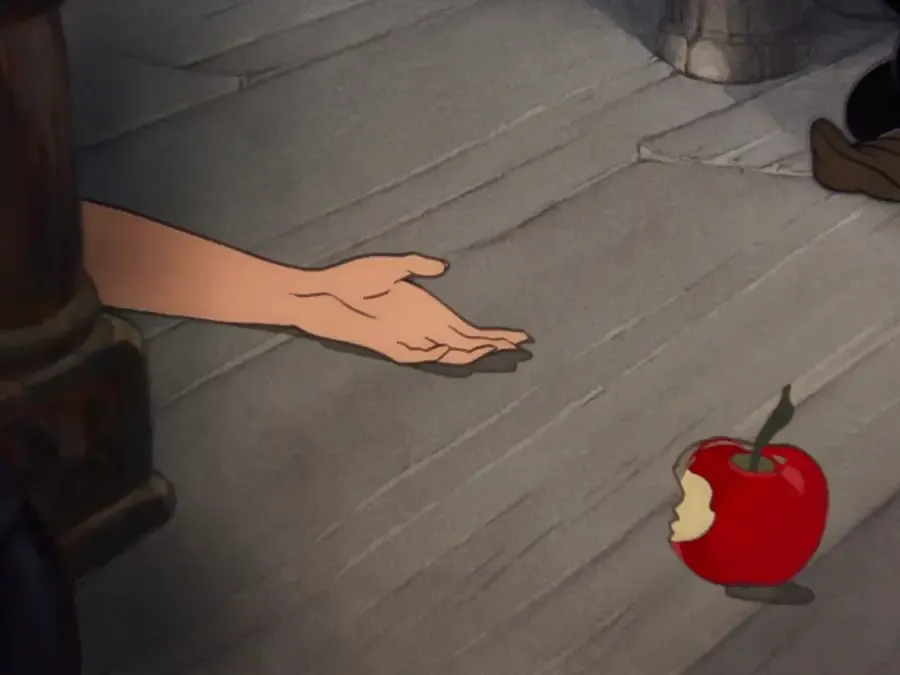
But no, apparently the image alludes to our mother Eve, reimagined as a contemporary femme fatale. I was like, duh—she is the original femme fatale!
I usually take a Monster with me whenever I drive to St. John’s. Falling asleep behind the wheel is a real danger. I’m not sure whether it’s a one-off thing, but I think Bad Apple is the best Monster flavor so far. Saint Augustine would have approved. He certainly had quite a lot to say about Eve, temptation, and the consequences of eating the forbidden fruit—which the Book of Genesis never actually identifies as an apple in the first place.
The so-called forbidden fruit—in Hebrew, פרי [pərî]—from the Tree of the Knowledge of Good and Evil in Genesis 2.16-17 and chapter 3 is not named or specified. However, we do know that the Tree of the Knowledge of Good and Evil is metaphorical, and thus its fruit is also figurative.
In Christian theology and art, the apple became associated with the fruit of the Tree of the Knowledge of Good and Evil due to the tree’s name in Saint Jerome’s Vulgate: lignum scientiae bonī et malī.1 Here, malī is the genitive form of the noun malum, derived from the adjective malus, meaning “evil.” Interestingly, mālum is also the Latin word for “apple,” borrowed from the Greek μῆλον [melon] or “apple.”2 Consequently, the connection between the apple and the infamous fruit in Genesis likely stems from either a deliberate wordplay on malum or from the confusion that often arises with homonyms, such as malum [“evil”] and mālum [“apple”].3
Opinions differ in Jewish tradition regarding the identity of the fruit. The Talmūḏ (Bərāḵōṯ 40a; Sanhedrin 70b) and the Miḏrash (Bǝrêshîṯ Rabah 15.7) suggest that it was wheat, while also proposing that it could have been the fig—or the אתרוג [etrôg], which is the citron. In Kabbalistic circles, theories point to grapes or wine (Zōhar 1.73a).4
I personally lean toward the theories that identify the fruit as the etrôg and/or the fig. I prefer the etrôg due to my fondness for citrus fruits, and I find the fig fitting within the context of the story. After eating the fruit, the Man and the Woman realized they were naked, “and they sewed fig leaves together and made loincloths for themselves” (Genesis 3.7). If this is the case, the Talmūḏ’s explanation makes perfect sense: “They were rectified by that with which they were made low.”
 © 1937 The Walt Disney Company. All rights reserved..
How and—most of all—how not to eat fruit. Yes, yes, we know already: fruit is healthy. But that does not mean it belongs in everything we eat. Fruit should never be used as an ingredient in meat, poultry, seafood, or vegetable dishes, whether viands, entrées, or salads. And it should never find its way onto pizzas or into sandwiches. Fruit is eaten by itself—as dessert, a snack, or simply a meal on its own. Of course, it is perfectly normal and acceptable—and delightful—in cakes and pastries.
Hence, avocados and mangoes—especially mangoes!—have absolutely no business being sandwich fillings. And, for the love of all that is edible, pineapple should never share a pizza with baked dough, tomato sauce, cheese, and pepperoni. Yuck! This is precisely why I do not, and never will, eat guacamole or the Filipino stew puchero. Some culinary combinations are simply beyond redemption.
Ultimately, it all boils down to the distinction between knowledge and wisdom. Knowledge is knowing that a tomato is a fruit. Wisdom is knowing not to put it in a bowl of fruit salad.
1. Carol Meyers, Rediscovering Eve: Ancient Israelite Women in Context (New York: Oxford University Press, 2013), 60–61.
2. Michel Pastoureau, “Bonum, malum, pomum: Une histoire symbolique de la pomme,” in L’Arbre: Histoire naturelle et symbolique de l’arbre, du bois et du fruit au Moyen Âge, ed. Michel Pastoureau (Paris: Le Léopard d’or, 1993), 157–58.
3. Hilário Franco Júnior, “Entre la figue et la pomme: L’iconographie romane du fruit défendu,” Revue de l’histoire des religions 223, no. 1 (March 1, 2006): 45–46.
4. Mateusz Kusio, “Nathanael, the Fig Tree, and the Retrieval of Johannine Polysemy,” New Testament Studies 71, no. 3 (July 2025): 368–69.