How not to unpack a disappointment
You may want to listen to this piece while reading the essay. Composed by Ramin Djawadi, the musical genius behind Game of Thrones, “Stay a Thousand Years” never appeared in an episode, although it was included on the Season 8 soundtrack. It is a haunting ode to Daenerys, for whom Djawadi clearly has great affection. It could have accompanied her coronation. Or her funeral. Both of which she was denied . . .
℗ & © 2019 WaterTower Music. All rights reserved.
The collapse of Game of Thrones was so extraordinary that it deserves to be studied at universities as an example of how to dismantle a masterwork.
Game of Thrones premiered on 17 April 2011—my fortieth birthday. That coincidence has always given the series a particularly personal significance for me. But I did not actually see it until the following year, when the first season was released on Blu-ray. I even got into a car accident on my way to Walmart to buy it! Fortunately, I was unhurt, although my car suffered some damage. I subscribed to HBO to watch the second season, and before it ended, I had devoured all of the five novels.
I had become thoroughly immersed in Westeros, but it was Daenerys who made me fall in love with the series and the books. Of all the characters, she was the one in whom I recognized something of myself: her struggle to rise above circumstances she had not chosen, her refusal to accept the place to which others had consigned her, and her determination to carve out a home in a world unwilling to give her one. Her story was, for me, the heart of the series. I followed her triumphs and defeats with an attachment that went beyond ordinary admiration for a fictional character; I cared about what became of her because her resolve, defiance, fight, and perseverance felt intensely personal. While the earlier seasons were exceptional for their elaborate political drama, magnificent costumes, and willingness to subvert entertainment conventions, everything else—to me—existed around her.
I once imagined watching the entire series again after its conclusion, returning to the beginning with a fuller understanding of everything Daenerys had endured. I had no idea that the story I loved most would become the reason I can never bear to watch it again. That pleasure has been taken away, and the reason is simple: I know everything leads only to this nonsense . . .
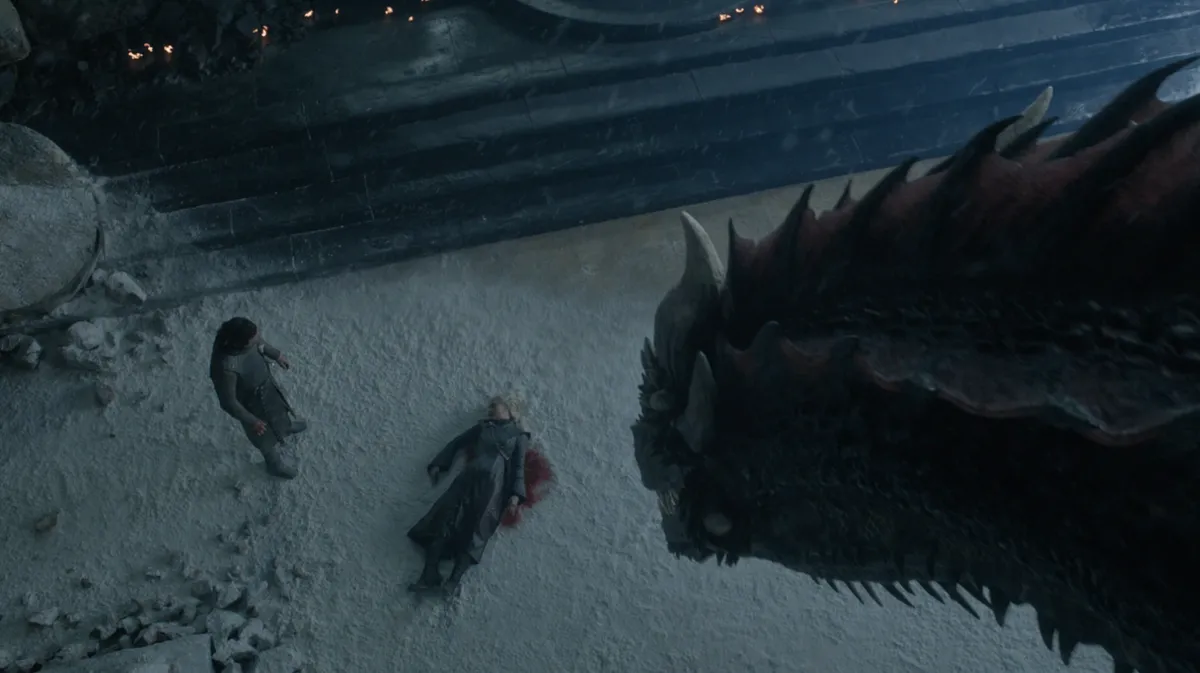 All images from Game of Thrones © Home Box Office, Inc. All rights reserved.
As the series progressed, its success brought enormous production budgets, and the visual spectacle became more elaborate with each season. Individual episodes began to resemble major motion pictures with breathtaking visual effects, but the writing no longer kept pace. Gradually, the narrative complexity that distinguished the early seasons gave way to a succession of extravagant, plot-driven events rather than organic consequences.
By the final two seasons, this deterioration was impossible to ignore. Characters made decisions inconsistent with established personalities, complex political conflicts were resolved with astonishing convenience, and military logistics only mattered when the writers found them useful. The show continued to look magnificent—featuring dragons, burning cities, and expensive displays of destruction—yet beneath this machinery, the story was evaporating. But most of us were not watching to see CGI spectacles; we were watching because we cared about the characters, and above all, because I cared about Daenerys.
The eighth season exposed the full extent of the damage. The supernatural threat that had loomed over the entire series was eliminated with astonishing haste. Worse still was Daenerys’ transformation into the show’s archvillain—an abrupt and unconvincing pivot that betrayed everything established about her character. While capable of ruthlessness, her lifelong struggle against oppression and tyranny made her a complex figure, not someone destined to become a monster. After everything she represented, why did her story have to end by turning her into the very evil she fought?
This disappointment was not about missing a happy ending—the show’s willingness to deny comfortable resolutions was initially one of its greatest strengths. The problem was an ending that ignored established histories and character arcs just to bring the production to a close. When that conclusion failed, the damage extended backward. Storylines led nowhere, mysteries were abandoned, and years of character development were discarded. Everything had been building toward something, and when that something arrived, what preceded it was rendered meaningless.
Much of the responsibility rests on the producers—or “showrunners,” as they were then called—David Benioff and D. B. Weiss. Having inherited a brilliant fictional world, they demonstrated considerable skill while adapting George R. R. Martin’s novels. Yet as they moved beyond the published text, the intricate plotting dissolved into an unseemly rush to finish and move on to other projects.
Martin himself is hardly blameless. His failure to complete the novels deprived the adaptation of its foundational literary map, while his dismissive and ungrateful attitude toward frustrated readers displays a remarkable disregard for the very people whose loyalty made him rich and famous.
Nor do the actors escape criticism. Some responded to the audience’s disappointment with astonishing condescension and arrogance, treating fans who objected to the ending as though they were ignorant, unreasonable, or simply unworthy of being heard. They remain active in the industry, of course, but none have recaptured the extraordinary fame and cultural prominence they enjoyed during Game of Thrones.
We, the fans, deserved better. And perhaps we have had our justice after all: the remarkable evisceration of Game of Thrones from the cultural landscape, along with the once-commanding prominence of so many who brought it to the screen.
Curiously enough, what prompted me to write this essay was the recent release of the 15th-anniversary Game of Thrones 4K SteelBook box set . . .
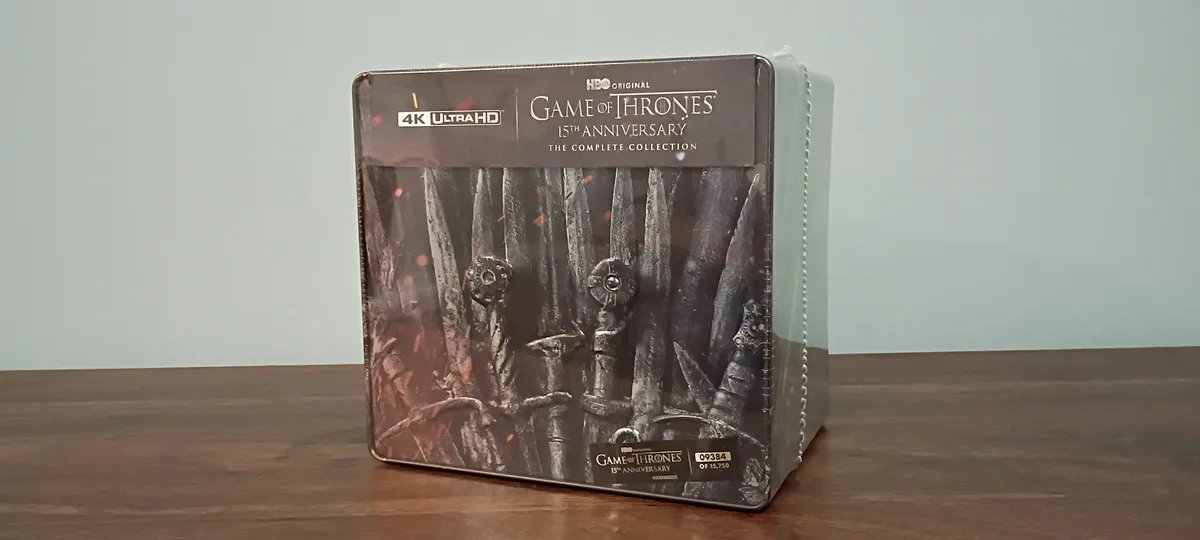
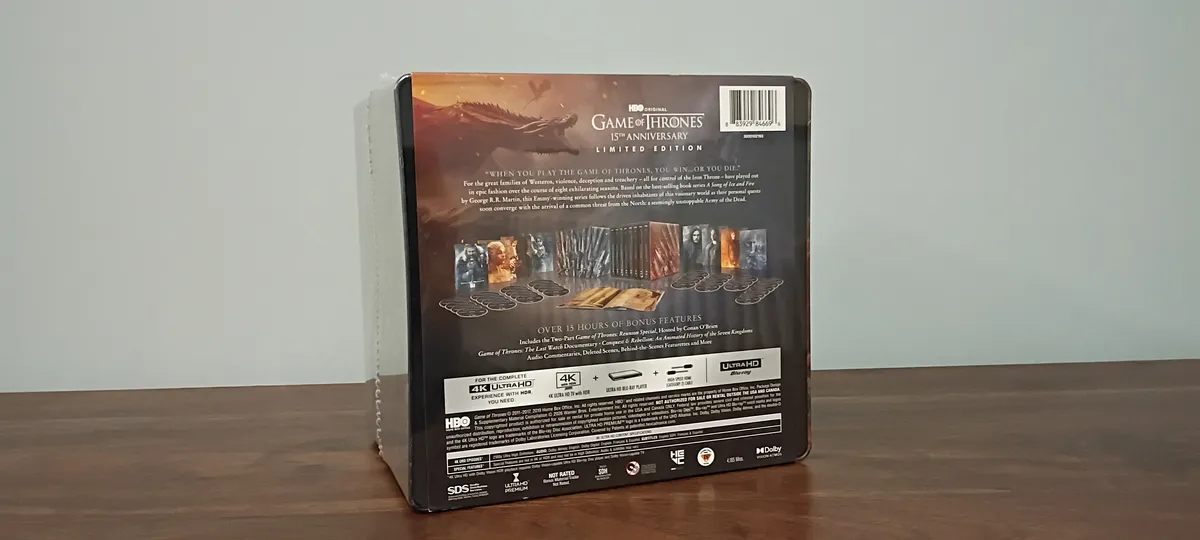
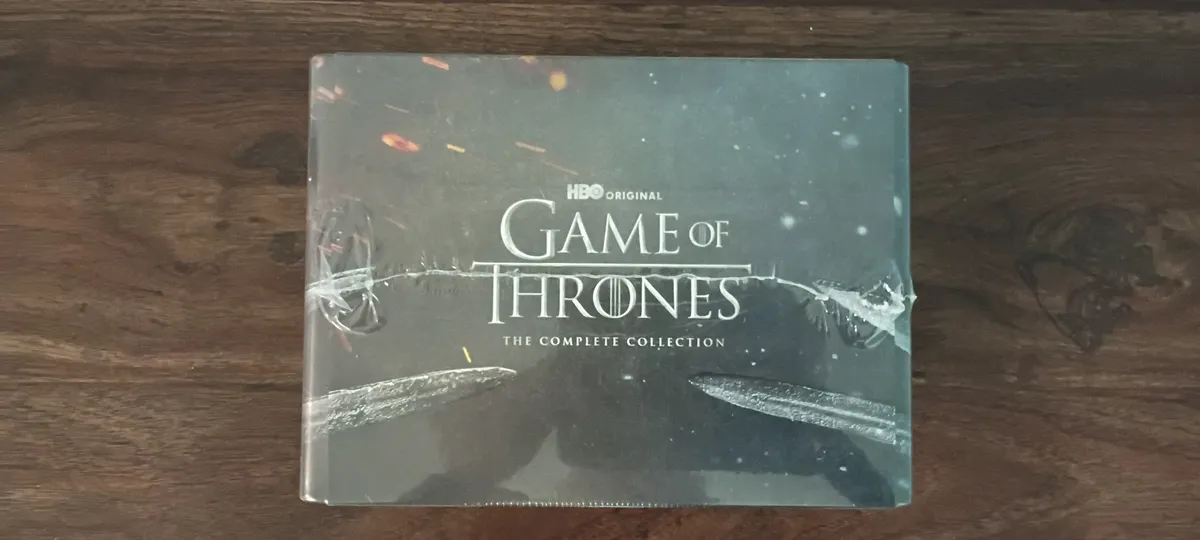
I see no reason to open it. There are already plenty of unboxing videos on YouTube for anyone curious about its contents. Besides, there’s really nothing about it that would make me jump up and down with excitement. Even the limited-edition numbering label is just a cheap sticker, carelessly slapped onto the tin . . .
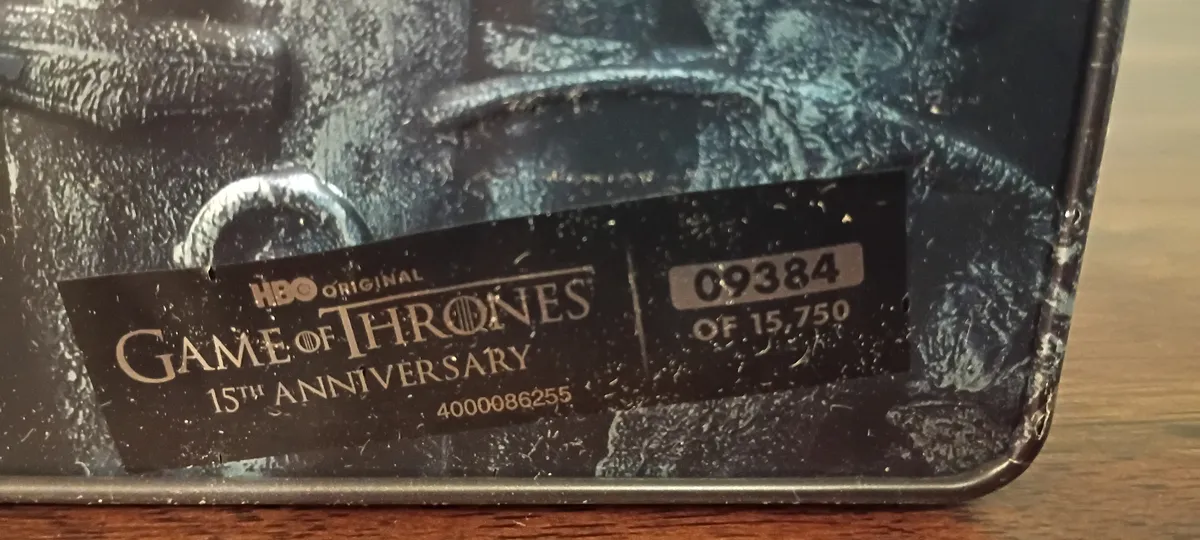
And judging from the unboxing videos, every copy has been treated with the same astonishing contemptuous disregard for quality.
When I return home to St. John’s, the set will simply take its place in the great Game of Thrones shrine I have assembled in my library. Yes, I bought it despite everything I have just said. I am, after all, still a collector—and a completist at that.
HBO can continue releasing anniversary editions, elaborate Blu-ray collections, and expensive 4K steelbooks. It can celebrate the show’s achievements, promote its fictional world, and produce further adaptations set within it. None of these efforts can change what happened to the original series. Indeed, there is something almost absurd about commemorating its anniversary with luxurious new editions when the very ending of the story has made so many fans reluctant to revisit it. However beautiful the packaging may be, it still contains the same ruined conclusion . . .
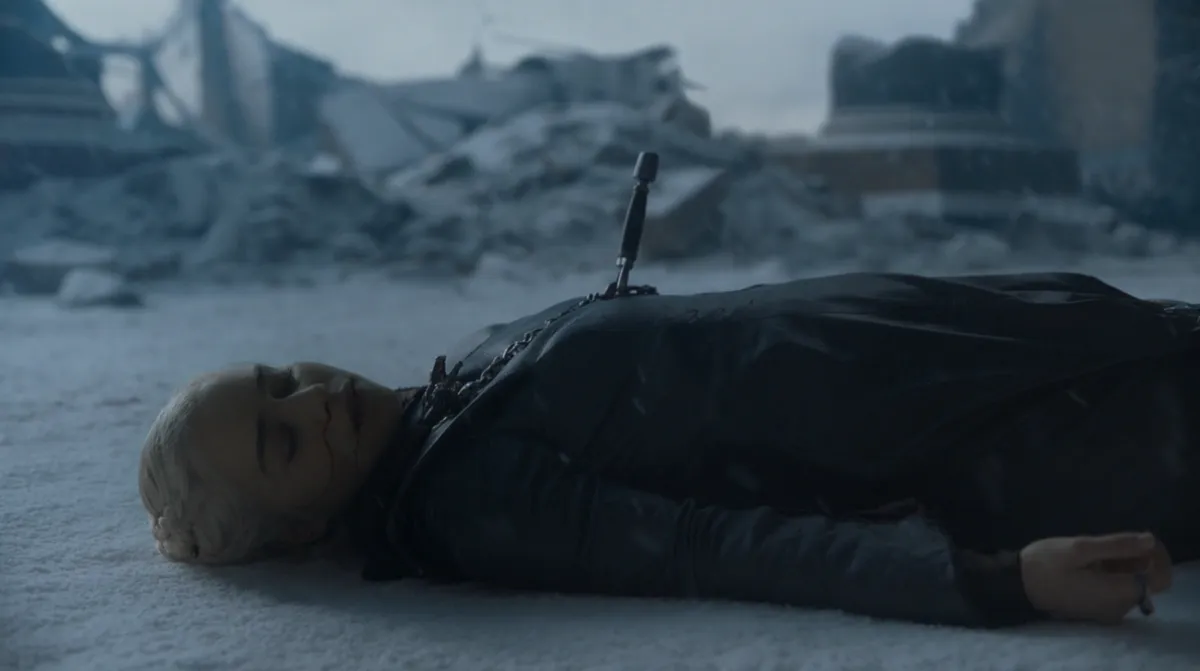
When asked if I would recommend the series to a newcomer, my answer is regretfully no. The better the early seasons appear, the more painful the eventual disappointment becomes. Occasionally, I still feel the pull of Westeros and the desire to reexperience its early brilliance, but I am immediately met by the abandoned arcs, the memory of the final season, and the fate of Daenerys. The desire vanishes instantly.
That is the true tragedy of Game of Thrones. Its ending was so disastrous that it robbed us of the pleasure of remembering everything we once loved about it.

Con-ned. Oh, and by the way, two weeks before Season 7 premiered on 16 July 2017, Jay and I went to Nashville to attend the first-ever Con of Thrones, held from 30 June to 2 July at the Gaylord Opryland Resort & Convention Center. It was the first major fan convention dedicated to HBO’s Game of Thrones and George R. R. Martin’s A Song of Ice and Fire . . .

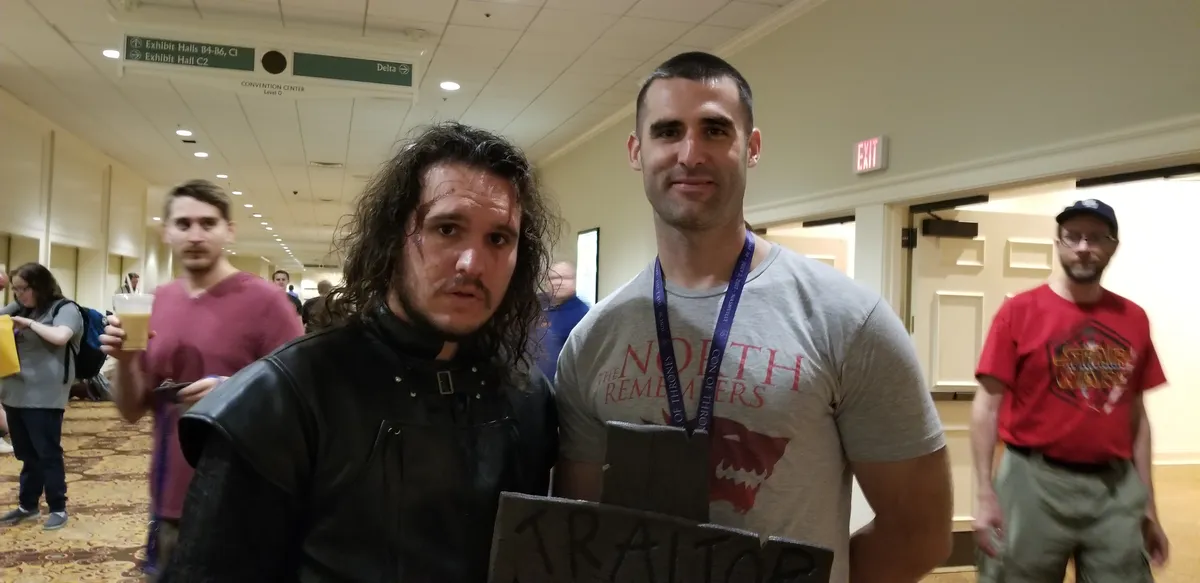
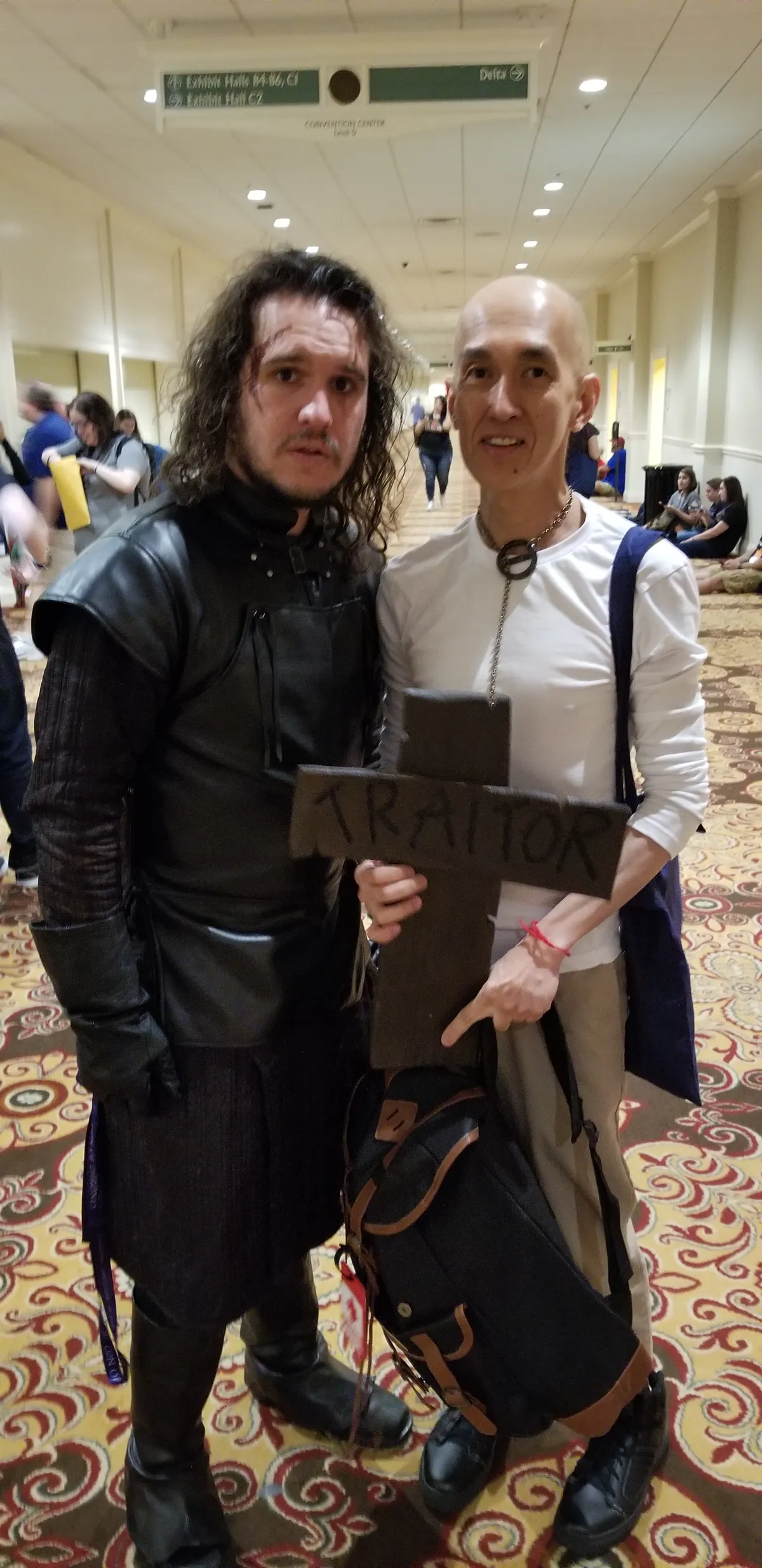
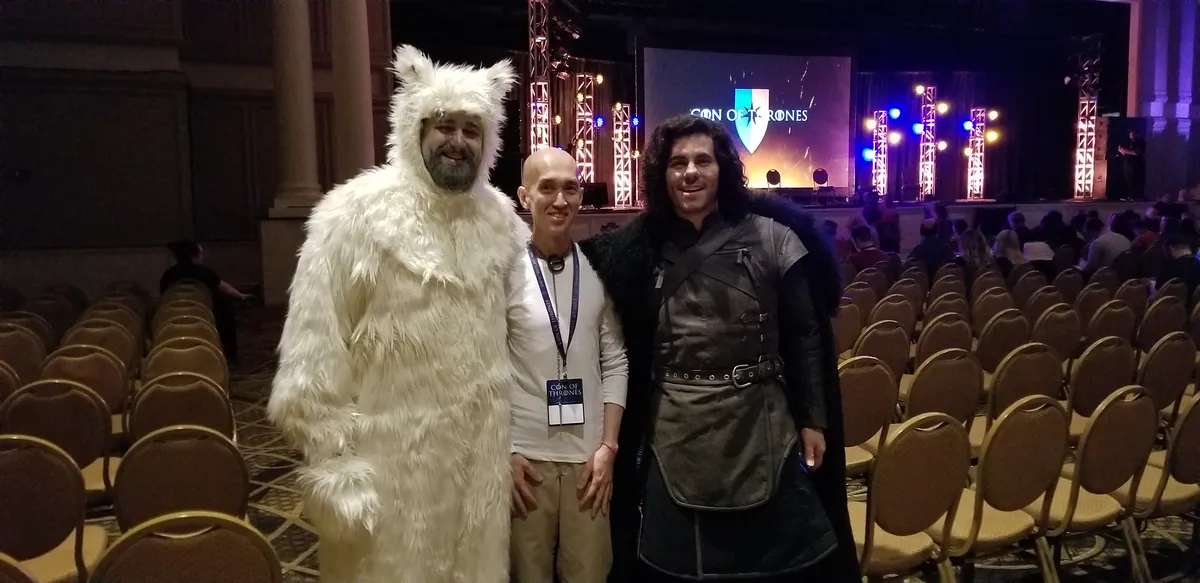
It featured panel discussions and cosplay. We got to pose with a few professional cosplayers, including one playing Jon Snow. Although I don’t understand why he had a cross—there’s no such thing as Christianity in Westeros . . .
There was also a pair playing Jon Snow and his dire wolf Ghost . . .
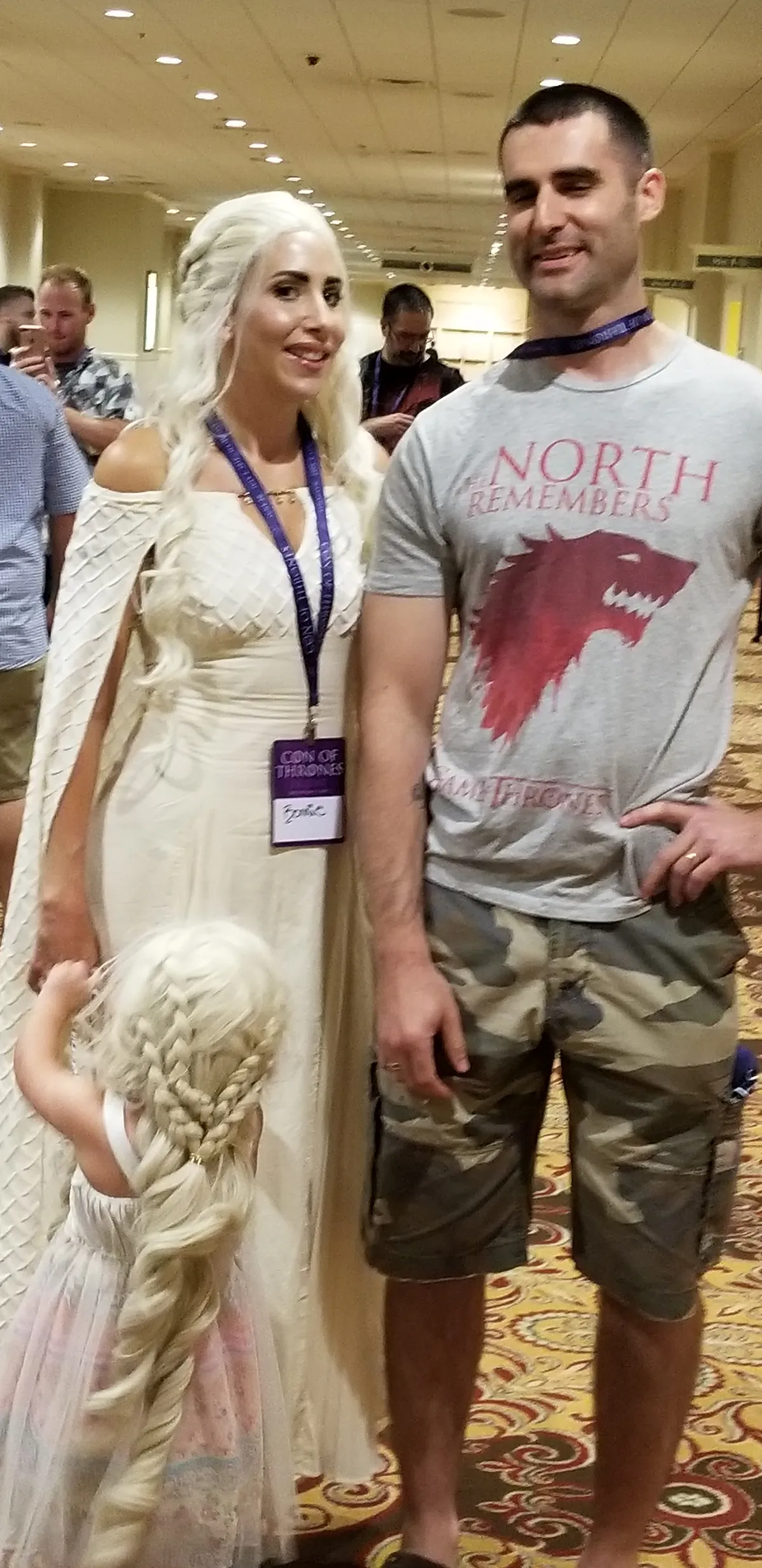
Jay posed with a lady dressed as Daenerys—although she really looked like the Red Woman . . .
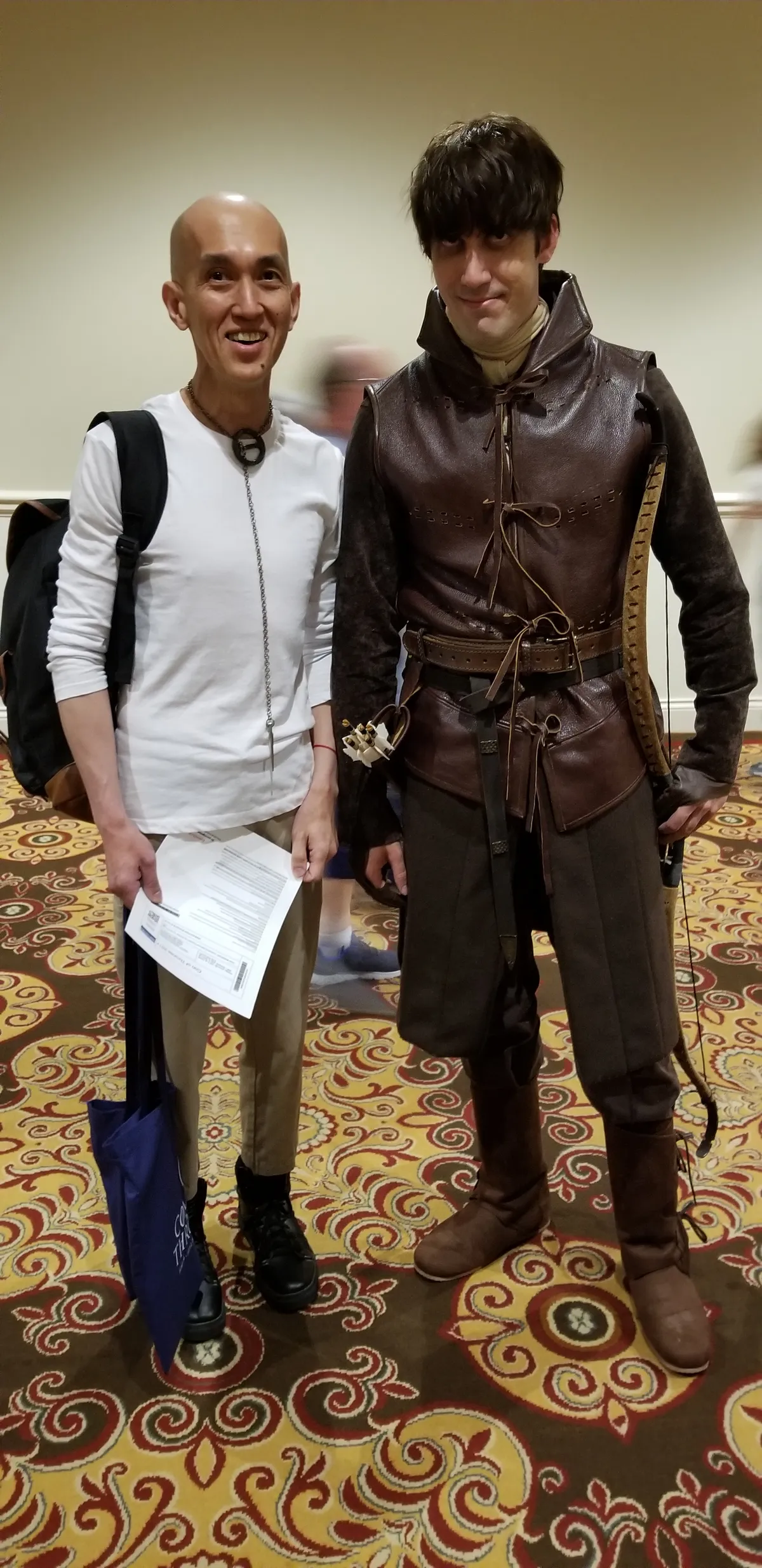
I posed with a cosplayer playing the bastard Ramsay Bolton . . .
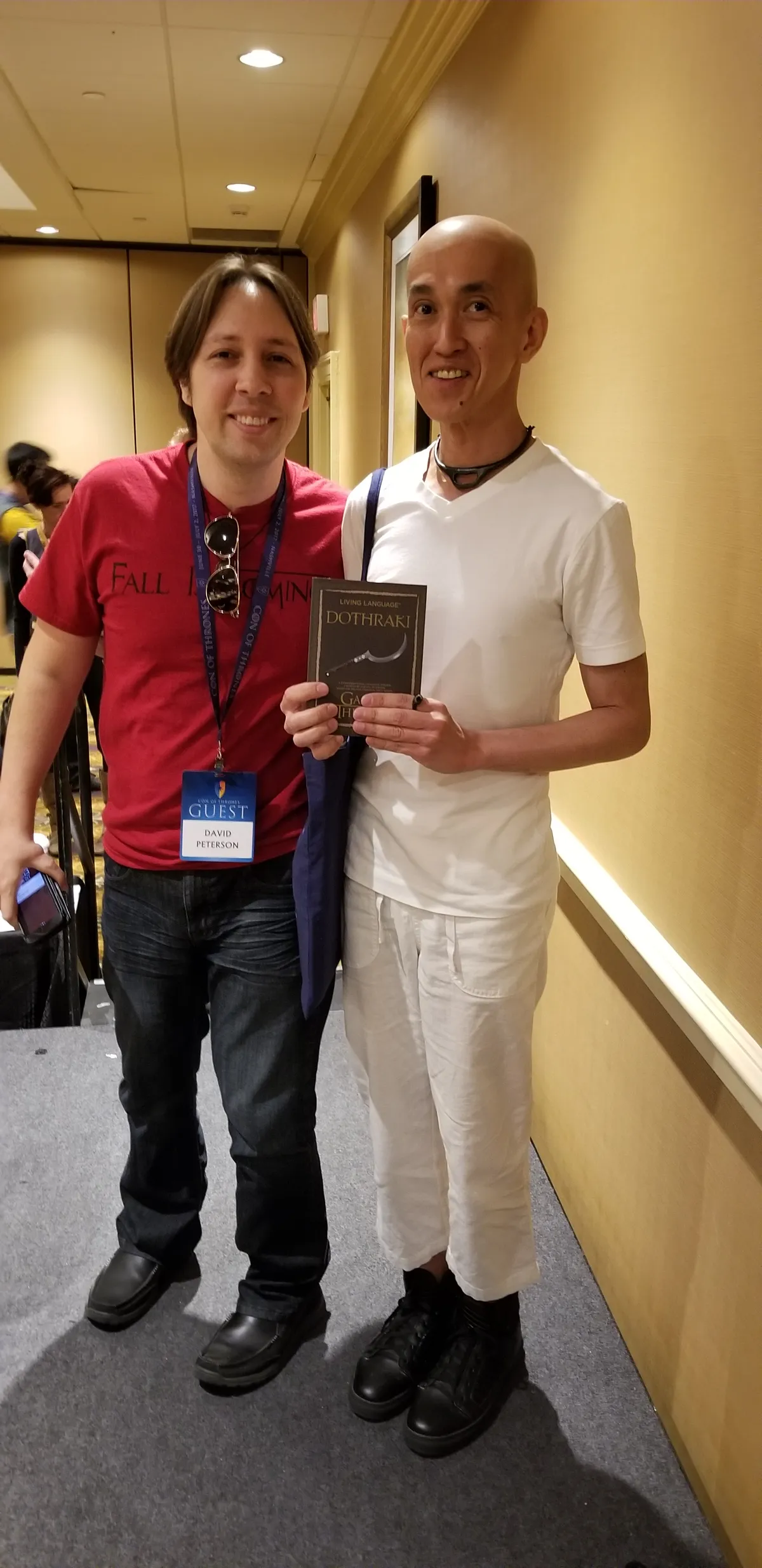
There were also autograph sessions. I had the amazing linguist David J. Peterson autograph my Dothraki grammar book. He developed the fictional Dothraki and High Valyrian languages for the show . . .
And, of course, there were cast appearances. The biggest cast member they managed to get was Iwan Rheon, who played Ramsay Bolton. A very friendly and personable guy . . .
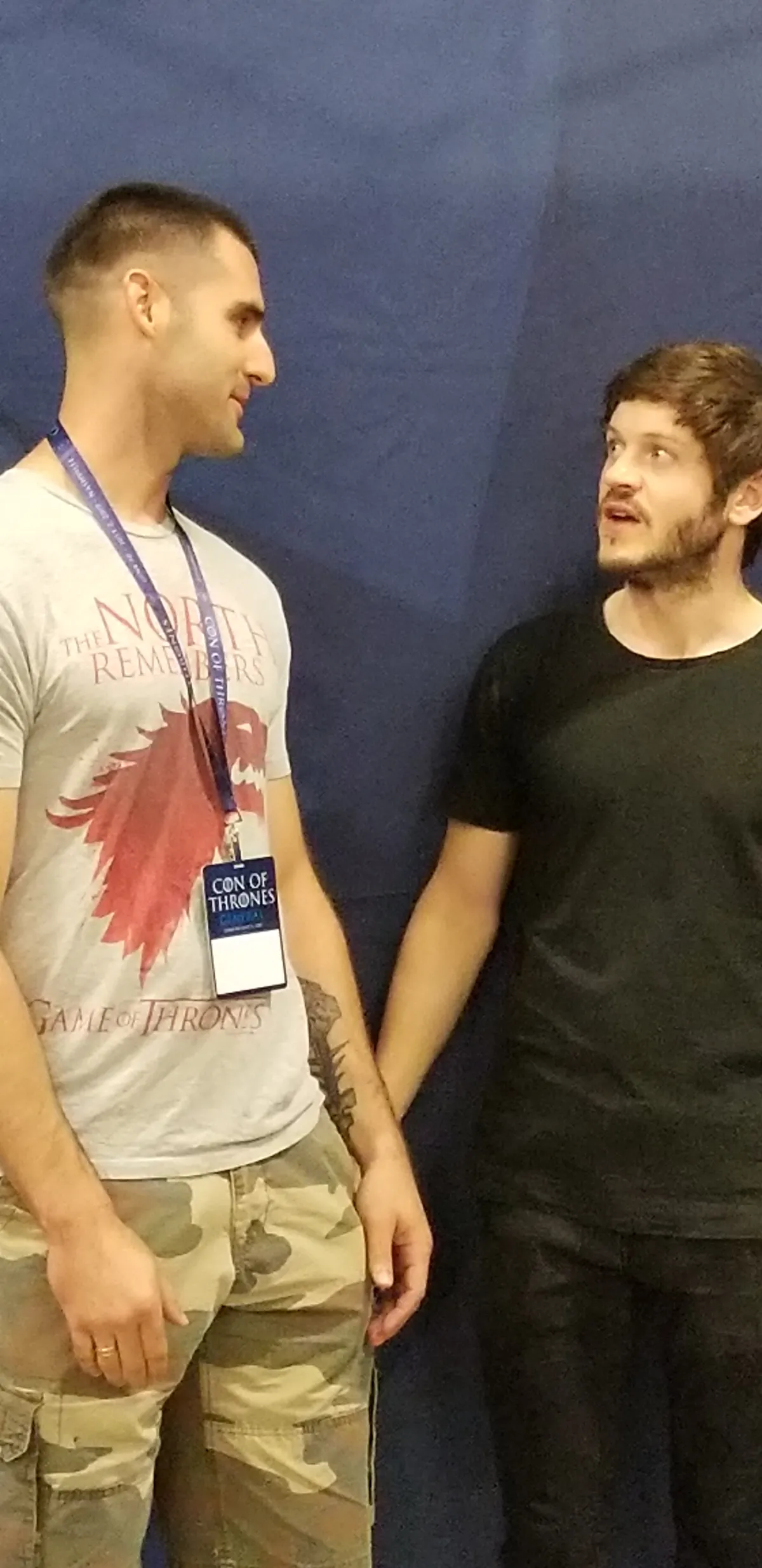
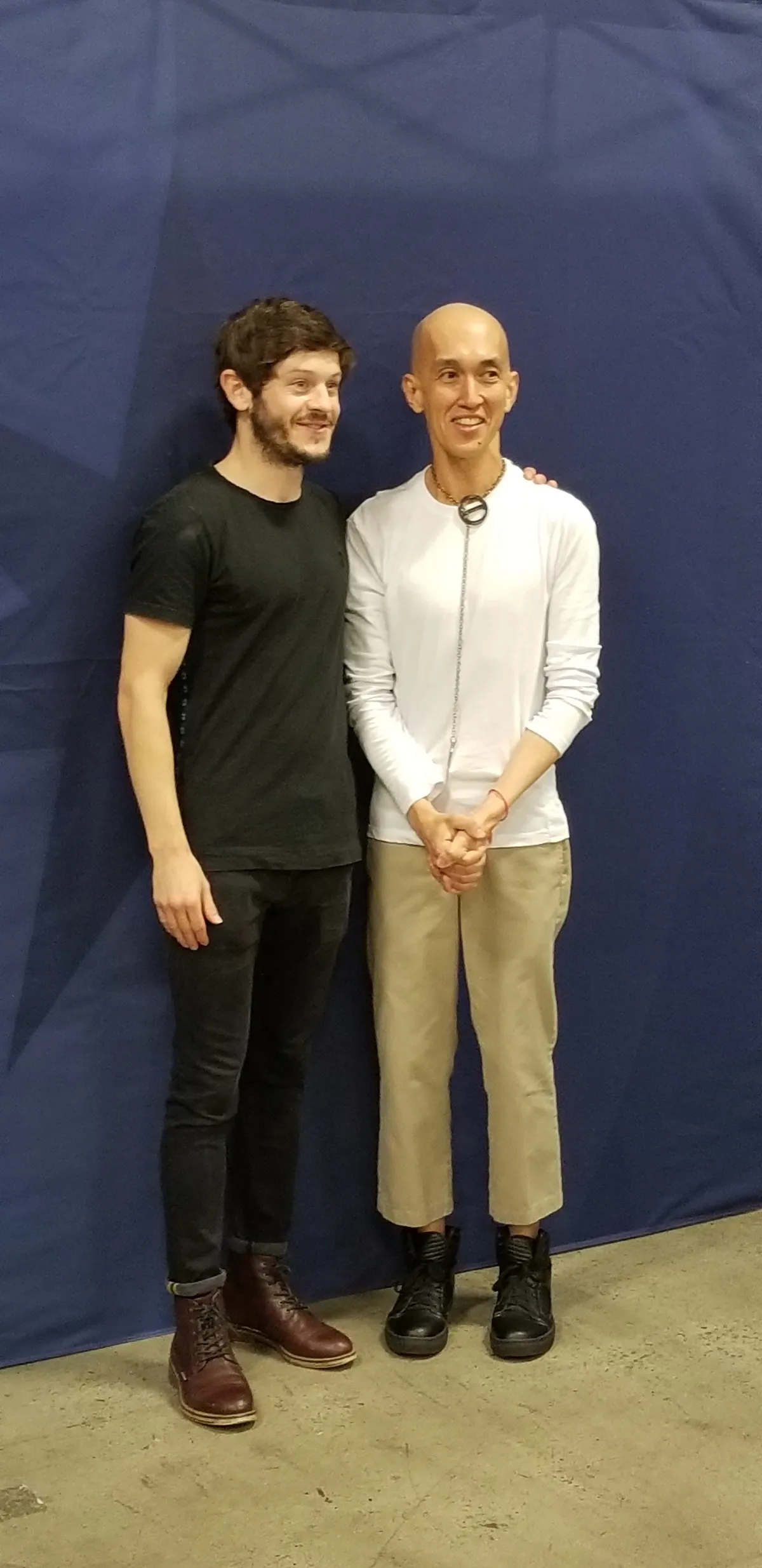
Looking back, we truly had a wonderful time. Little did we know then that the worst was yet to come.
“Father of Dragons.” Some years back, while Italian artist Max Rimbaldi was illustrating one of my manuscripts, she created this rather extraordinary portrait of me as Daenerys, complete with a newly hatched Drogon perched on my shoulder. My friends and brothers absolutely hate it. They were horrified . . .
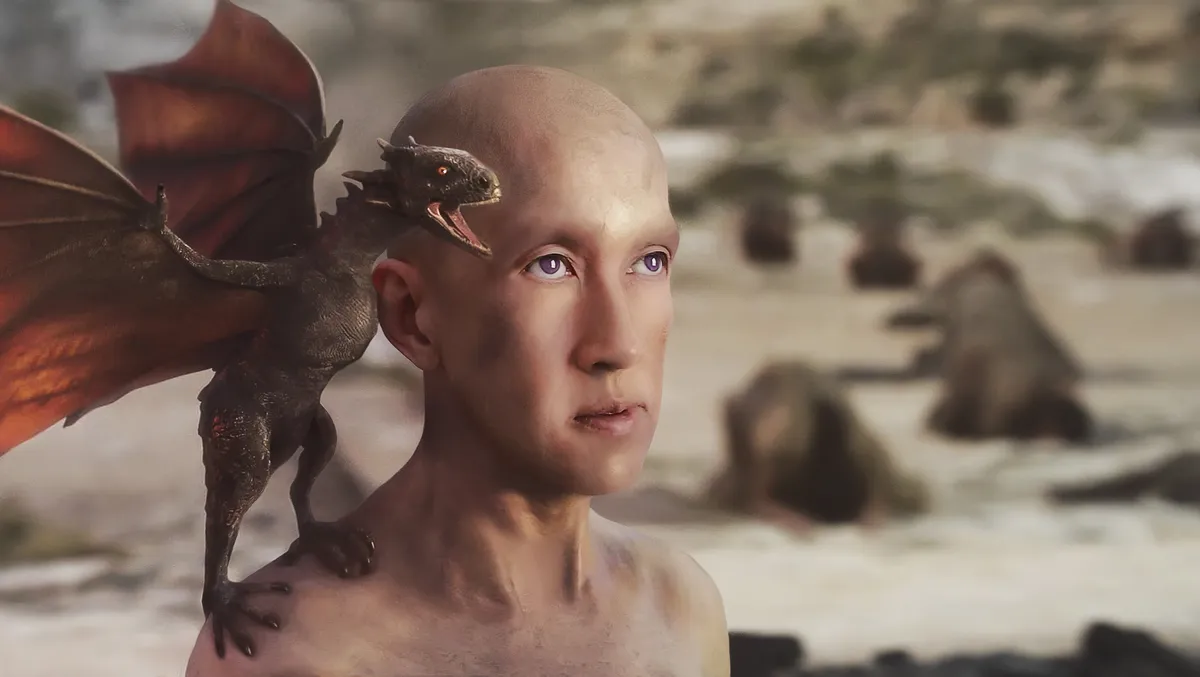 Illustration by Max Rimbaldi, after Game of Thrones (HBO).
Naturally, I adore it 😂. The portrait is also more faithful to the first novel than to the TV series. In A Game of Thrones, Daenerys emerges from Khal Drogo’s funeral pyre with her hair completely burned away, while the distinctive violet eyes reflect her Targaryen ancestry. Hence my magnificent bald head and purple eyes. The composition itself recreates the unforgettable final scene of the show’s first-season finale.
I suppose every devoted fan of Daenerys deserves an opportunity to become a Targaryen, even if only for a portrait. And if my friends and brothers find the result disturbing, they would do well to remember: the dragon does not concern itself with the opinions of sheep!