Edicts masquerading as requests
Somewhere along the way, modern Christianity has acquired a very strange God. He is unfailingly polite, endlessly accommodating, terrified of offending anyone, and apparently incapable of issuing a command.
He stands at the door of the human heart, hat in hand, hoping to be admitted. He makes suggestions, extends invitations, and waits patiently for our response. If we decline, He smiles understandingly, because, after all, He respects our free will.
What a remarkable transformation! The Almighty, Creator of heaven and earth, has become a nervous Gentleman afraid of imposing Himself upon His own creatures. The Lord of history has been reduced to a solicitous Host whose greatest concern is that nobody should feel uncomfortable. And much contemporary preaching seems determined to keep Him that way.
But listen to the language of the Gospels.
In Mark 1.15, Jesus proclaims: “Μετανοεῖτε!” [Metanoeîte]—“Repent!” An imperative.
In Mark 1.17, Jesus commands Simon and Andrew, the first two disciples He calls: “Δεῦτε ὀπίσω μου” [Deûte opísō mou]—“Follow me.” The expression is literally “Come after me,” with deûte functioning as an imperative summons. Jesus does not ask whether they might be interested in joining His movement. He commands them to follow.
In Matthew 9.9, Jesus does not say, “Matty, would you perhaps consider following Me, if it is convenient and consistent with your personal aspirations?” What He says is “Ἀκολούθει Μοι” [Akoloúthei Moi]: “Follow me.” The verb is again in the imperative mood.
In Matthew 11.28, He says: “Δεῦτε πρός Με” [Deûte pros Me]—“Come to me.” Another imperative summons.
These are not the hesitant proposals of someone seeking approval. They are imperatives. The Kingdom of God does not arrive as an item on a menu of lifestyle choices. It arrives with a demand.1
Yet listen to the typical Sunday homily. God is “inviting us” to become better people. Jesus is “inviting us” to love our neighbors. The Gospel is “inviting us” to repent, to turn away from sin, to forgive. Everything is an invitation. Apparently, God has stopped commanding anything.
And whenever the authority of God becomes uncomfortable, the preacher produces the great theological escape clause of our age: God “respects” our free will.2
Of course, human beings possess freedom. Of course, love cannot be manufactured through compulsion. But since when does the freedom to disobey a command mean that no command has been given? Since when does the capacity to refuse an obligation abolish the obligation itself?
A king does not cease to be king because his subjects can rebel. A law does not become a recommendation because someone is capable of breaking it. And God does not surrender His authority simply because human beings possess the astonishing ability to tell Him No.
What free will gives us is the capacity to choose. What it does not give us is the authority to decide that God’s commandments are optional (Deuteronomy 30.15–20; Sirach 15.14–17).3
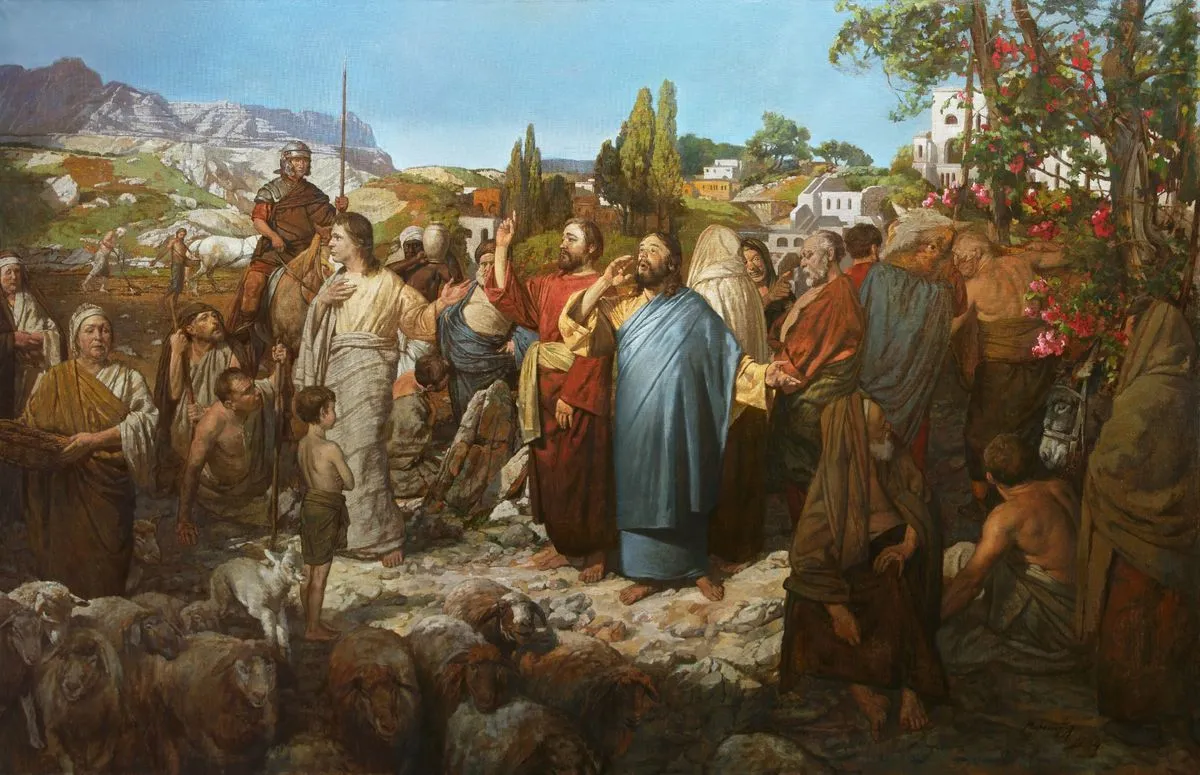 The Parable of the Wedding Feast by Andrei Mironov. © 2014 by the artist. Licensed under CC BY-SA 4.0.
The King who does not beg. Consider the parable of the wedding banquet in Matthew 22.1–14.
Jesus describes a king who prepares a wedding feast for his son. He sends his servants to summon those who have already been invited. They refuse to come. The king sends more servants with another message: the banquet is ready, everything has been prepared, and the guests must come.
In Matthew 22.4, the command is unmistakable: “Δεῦτε εἰς τοὺς γάμους” [Deûte eis toùs gámous]—“Come to the wedding banquet.” It is the same imperative summons that Jesus uses elsewhere in the Gospels.
But the guests are unimpressed. Some go away to their farms and businesses. Others seize the king’s servants, mistreat them, and kill them. The king responds with judgment. He sends his troops, destroys the murderers, and burns their city. Then he orders his servants into the streets to summon others, and the banquet hall fills with guests.
That is hardly the story of a timid host who respects everyone’s decision and quietly adjusts his seating arrangements.
Notice something important about the original wording.
In Matthew 22.14, the parable concludes with the familiar declaration, “Πολλοὶ γάρ εἰσιν κλητοί, ὀλίγοι δὲ ἐκλεκτοί” [Polloì gár eisin klētoí, olígoi dè eklektoí]—“For many are called, but few are chosen.” The word κλητοί [klētoí] describes those who have been called or summoned. But earlier in the parable, in Matthew 22.9, the king commands his servants with the aorist imperative καλέσατε [kalésate]: “Invite!” or “Summon!” The distinction is significant. The guests are described as having received an invitation, but the servants receive an explicit command to issue it. What reaches the guests as an invitation originates in the authority of the king who orders it.4
Yes, there is an invitation. But it is a royal invitation, issued by a king to his subjects. That makes all the difference.
We seem to imagine that because the word “invitation” appears in the parable, the king must be behaving like a friendly neighbor inviting us over for dinner. Come if you like. No pressure. Bring a friend. Sorry if the invitation was inconvenient.
But this is not a neighborhood barbecue. This is the wedding banquet of the king’s son. The king is exercising royal authority, and the refusal of his summons has consequences.
The parable does not present obedience and disobedience as equally respectable expressions of individual autonomy. Nor does it portray the king as a helpless victim of his subjects’ superior freedom. The king summons, the guests refuse, and the king judges.5
And lest anyone imagine that simply entering the banquet is enough, the parable adds the disturbing episode of the guest without a wedding garment. Even those who have entered are not exempt from accountability (Matthew 22.11–13).
The banquet is a gift. The summons is authoritative. The judgment is real.
Modern preaching is often comfortable with the first sentence, embarrassed by the second, and desperate to explain away the third.
The idol that is free will. One of the strangest achievements of modern religious language is the elevation of human free will into something approaching divine sovereignty. We are repeatedly assured that God respects our freedom.
But the statement is often delivered with such extraordinary qualifications that God begins to resemble a powerless spectator in His own creation. He desires our conversion but apparently cannot demand it. He wants our obedience but must never insist upon it. He hopes we will choose him, but our refusal somehow places the matter beyond His authority.
The creature has become more formidable than the Creator. God, it seems, must tread carefully around us. We might be offended. We might accuse him of being authoritarian. We might stop attending church. Worst of all, we might exercise our free will and walk away.6
And so the preacher rushes to reassure us that God would never tell us what to do.
But the God of the Bible is not campaigning for our approval.
The commandments are called commandments for a reason. The prophets do not present God’s word as a series of interesting possibilities. John the Baptist does not gently suggest repentance to those who might find it personally enriching (Exodus 20.1–17; Matthew 3.1–2, 7–10).
Above all, Jesus does not negotiate the terms of discipleship with every prospective follower. He says, “Follow me.” He says, “Repent.” He says, “Go, and sin no more” (John 8.11). He says, “Love your enemies” (Matthew 5.44).
Those are demands, not dialogue, conversation, or discussion topics.
And the seriousness of the demand is precisely what makes human freedom morally significant. Without a command, disobedience becomes meaningless. Without obligation, repentance becomes merely a change of preference. Without judgment, mercy loses the very reality from which it delivers us.
The issue is not whether God can force us to obey. The issue is whether God has the right to command us even when we refuse.7
Christianity has always answered Yes.
Mercy is not permission. Perhaps nowhere has this confusion done more damage than in the preaching of divine mercy.
God is merciful. That is not in dispute. But mercy does not mean that sin has ceased to matter. Forgiveness does not imply that repentance is unnecessary. Patience does not signify indifference. And the fact that judgment may be delayed does not mean that judgment has been abolished (Ezekiel 18.21–23, 30–32; Romans 2.4–6; 2 Peter 3.9–10).8
The Jesus who welcomes sinners is also the Jesus who commands them to repent. The Jesus who forgives is also the Jesus who warns. The Jesus who speaks of the Father’s love is also the Jesus who tells parables about accountability, exclusion, and judgment. These are not two competing versions of Jesus, one loving and the other severe. He is the same Jesus. It takes a particularly selective reading of the Gospels to preserve His consolations while discarding His commands. (Luke 5.30–32; Mark 1.15; Matthew 7.21–23; 25.31–46).
Preachers have become so anxious to assure people that God loves them exactly as they are that they sometimes forget to tell them He commands them to become something they are not. And they have grown so accustomed to speaking of the unconditional love of God that they have begun to imagine an unconditional approval of everything we do.
But love is not approval. Mercy is not indulgence. And God’s willingness to forgive disobedience does not cancel His authority to demand obedience. Indeed, a God who has no authority to command can offer no meaningful forgiveness for disobedience. He can merely express His personal disappointment. That is not the God of the Gospels (John 14.15; Hebrews 12.5–11).
The Gospel has teeth. We need to recover something Christianity has been steadily losing in its desperate effort to appear agreeable: the fear of the Lord (Proverbs 1.7; 9.10; Psalm 111.10; Sirach 1.11–20; Luke 12.4–5).9
Not irrational terror. Not the grotesque image of a Deity who delights in punishment. But the recognition that God is God, that His authority is not subject to human approval, and that our lives are answerable to Him (Exodus 20.20; Deuteronomy 10.12–13; Psalm 130.3–4).10
The fear of God begins when we stop imagining ourselves as the ultimate judges of what God may reasonably demand of us. It begins when we understand that the Gospel is not a therapeutic suggestion designed to make our existing lives more comfortable. It is a summons to conversion, a demand for allegiance, and a call to abandon whatever stands between us and the Kingdom (Proverbs 3.5–7; Job 28.28; Philippians 2.12–13; Matthew 10.28).11
That summons is accompanied by extraordinary promises: forgiveness, reconciliation, eternal life, and the joy of the Kingdom itself. But those promises do not erase the command. They reveal the goodness of Him who commands (Mark 1.14–15; John 3.16–21; Romans 2.4).12
There is no contradiction between the generosity of the banquet and the authority of the king. There is no contradiction between divine love and divine judgment. There is no contradiction between human freedom and human accountability (Romans 11.22; Hebrews 10.30–31; Galatians 6.7–8).
The contradiction exists only in the sentimental religion we have invented to protect ourselves from the uncomfortable implications of the Gospel.
Perhaps it is time for preachers to stop apologizing for God’s authority. Perhaps it is time to stop translating every command into an invitation, every obligation into an option, and every warning into a reassuring metaphor.
Perhaps it is time to admit that the God proclaimed by Jesus Christ is not the harmless, accommodating figure so often presented from our pulpits. He is not a nervous Host begging us to attend His banquet.
He is the King.
And when the King says, “Come,” He is not asking whether we happen to be free that evening. He is summoning us. And we are free to refuse.
But we are not free to make that refusal inconsequential.
1. Richard B. Hays, “Whose World, Which Law?” Journal of Law and Religion 32, no. 1 (March 2017): 17–19.
2. Brian Hebblethwaite, “Freedom, Evil and Farrer,” New Blackfriars 66, no. 778 (April 1985): 178–180.
3. Paul Helm, “Grace and Causation,” Scottish Journal of Theology 32, no. 2 (April 1979): 101–103.
4. Klyne R. Snodgrass, Stories with Intent: A Comprehensive Guide to the Parables of Jesus (Grand Rapids: William B. Eerdmans, 2008), 299–301.
5. Randy Beck, “God the Judge and Human Justice,” Journal of Law and Religion 32, no. 1 (March 2017): 33–35.
6. James Wetzel, “The Recovery of Free Agency in the Theology of St. Augustine,” Harvard Theological Review 80, no. 1 (January 1987): 101–103.
7. Timothy Brennan, “Does Liberalism Need Free Will? Augustinianism, Pelagianism, and the Autobiography of Benjamin Franklin,” Modern Intellectual History 22, nos. 1–2 (March 2025): 28–30.
8. Thomas P. Dixon, “Judgement for Israel: The Marriage of Wrath and Mercy in Romans 9–11,” New Testament Studies 66, no. 4 (October 2020): 565–567.
9. Jeremy Corley, “Wisdom and Fear of God in Ben Sira 1:11–21: Second Temple Perspectives,” Journal for the Study of the Pseudepigrapha 30, no. 1 (September 2020): 46–48.
10. Matthew A. O’Kelly, “Wisdom and the Fear of YHWH: Rethinking Their Relationship in Proverbs 1–9,” Journal for the Study of the Old Testament 47, no. 1 (September 2022): 98–100.
11. Zoltán Schwáb, “Is Fear of the Lord the Source of Wisdom or Vice Versa?” Vetus Testamentum 63, no. 4 (2013): 652–654.
12. Matthew A. O’Kelly, “Introductory Matters: Tracing the Aims of Proverbs 1:1–7 through the Book’s First Collection,” Scottish Journal of Theology 78, no. 3 (August 2025): 252–254.