Doomsday, ’26
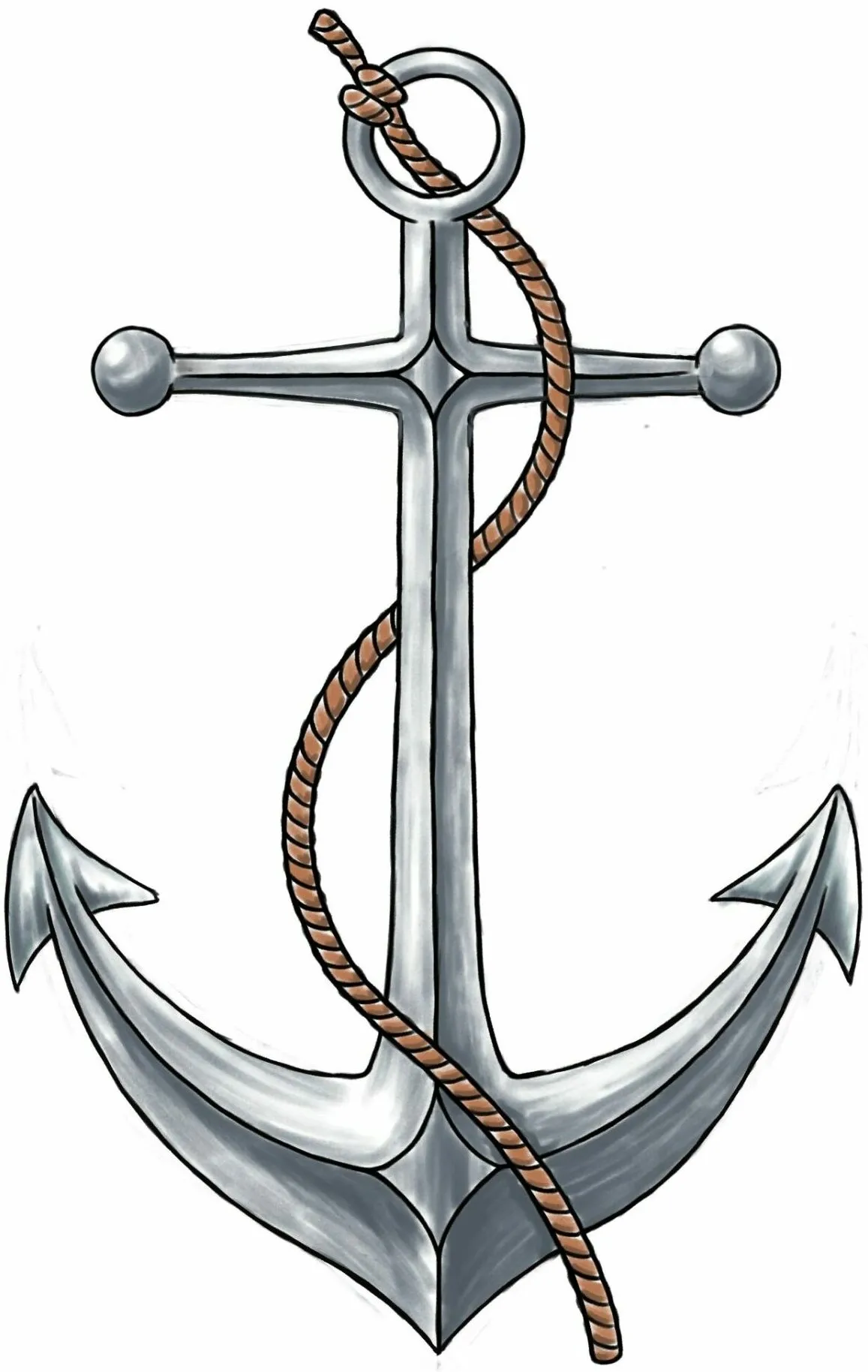
Christianity has long employed the anchor as a symbol of hope. Hebrews 6.19 describes that hope as an anchor for the soul, firm and secure. But there is an important question we seldom ask when invoking that familiar image: what, exactly, are we anchored to?
The world that was supposed to last. Rome is a good place to begin.
According to tradition, Rome was founded in 753 B.C. It passed from monarchy to republic and eventually, under Augustus in 27 B.C., became the center of an empire that extended across much of Europe, the Near East, and North Africa. By the beginning of the fifth century A.D., the Roman state had existed for more than eleven hundred years. Its institutions, laws, roads, cities, and armies had shaped the lives of generations.1
Rome was not merely a city. It was an idea of civilization itself. Emperors came and went. Dynasties rose and disappeared. Civil wars periodically threatened the state. Yet Rome endured. The empire had survived so many crises that its continued existence could almost be taken for granted.
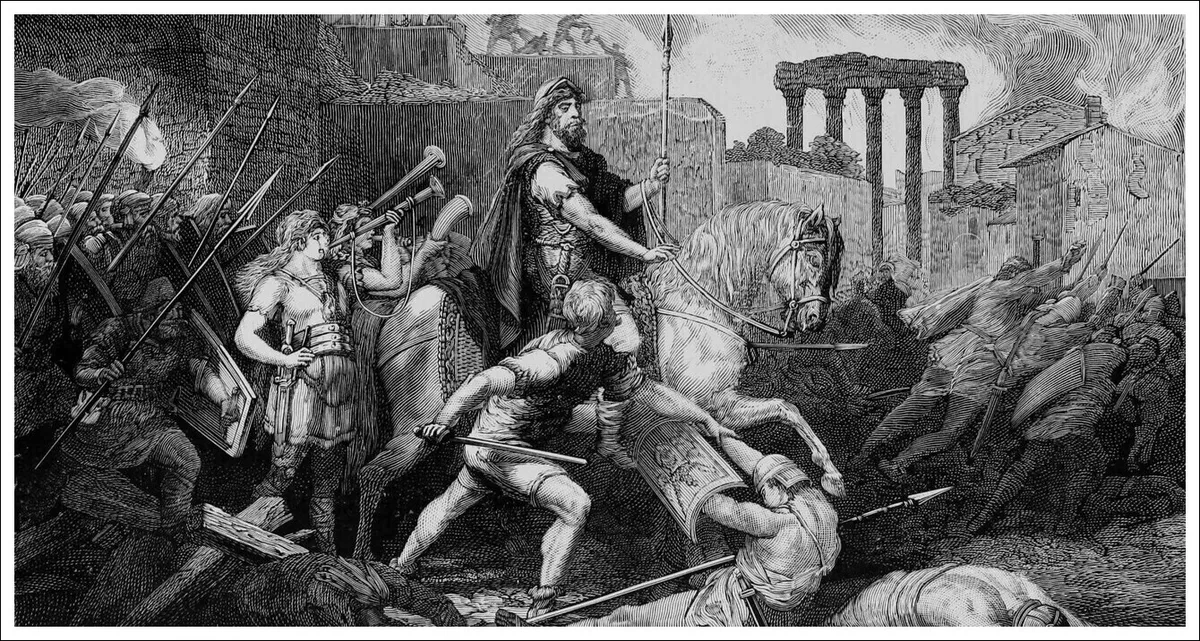 Alarichs Einzug in Rom, after Wilhelm von Lindenschmit the Younger, 1886. Public domain.
Then, in A.D. 410, Alaric and his Visigoths entered Rome and sacked the city.2
The event was ultra-shocking. Rome had not been captured by a foreign enemy for approximately eight centuries. Although the imperial government had long since established its principal western residence elsewhere, Rome retained an extraordinary symbolic importance. The city that had conquered nations, subdued kings, and imposed its authority upon much of the known world had itself fallen prey to invaders.
And there was a theological embarrassment in all this. The event provoked questions about Roman power, Christian faith, and the apparent collapse of a civilization that had seemed almost permanent.3
Christianity had become the dominant religion of the Roman Empire. Its emperors professed the Christian faith, its bishops enjoyed imperial recognition, and its churches had become increasingly prominent features of Roman society. Surely the Christian God would protect the Christian empire!
Some adherents of Rome’s indigenous religions had another explanation. Rome had prospered for centuries under the protection of its ancestral gods. Now that those gods had been abandoned, disaster had followed. Christianity, they argued, had weakened the very civilization it claimed to have redeemed.
The Christians were not necessarily any more comfortable with the situation. If the empire that had embraced Christianity could suffer such a humiliation, what did that say about divine protection?4
It was an awkward question. And one that a certain bishop in North Africa was unwilling to leave unanswered.
Augustine’s inconvenient answer. Augustine was Bishop of Hippo, in what is now Algeria, when news of Rome’s sack reached North Africa. Refugees arrived from Italy, carrying accounts of the disaster.
So around 413, Augustine began writing Dē cīvitāte Deī [The City of God, or more correctly, On the Commonwealth of God], an enormous work of twenty-two books that he completed around 426. It was partly a response to pagan accusations against Christianity, but its argument developed into something far more consequential: an examination of human history, political power, and the ultimate destiny of humanity.5
Augustine rejected the assumption that Rome’s greatness proved the favour of its gods. Nor did he accept the opposite assumption that Rome’s conversion to Christianity entitled it to permanent divine protection.
In other words, becoming Christian did not make Rome indestructible. That was a lesson Christians needed to hear.
For Augustine, the fundamental distinction was not between Roman and barbarian, Christian emperor and pagan emperor, or even one political system and another. It was between two “cities,” constituted by two different kinds of love: the earthly city, characterized by love of self even to the contempt of God, and the City of God, characterized by love of God even to the contempt of self.
These were not simply two competing geographical territories. Their citizens lived alongside one another throughout history, sometimes within the same institutions, and would not be finally separated until God’s judgment.
The Roman Empire, whatever its accomplishments, belonged to the passing arrangements of human history. It could administer justice or perpetrate injustice, protect its citizens or oppress them, establish peace or wage war. But its survival was not a condition of Christianity’s survival. It was not the Kingdom of God.
The distinction should have been obvious. Christianity had existed before the emperors embraced it, and it would continue to exist after the emperors were gone. Nevertheless, centuries of Roman power had made it tempting to identify the fortunes of the Church with the fortunes of the empire. Augustine was reminding Christians that they had dropped their anchor in the wrong place.
The Western Roman Empire eventually came to its conventional end in 476, when Odoacer deposed Romulus Augustulus.6 Augustine never lived to see it. He died in 430, while the Vandals were besieging Hippo.
Even the bishop who had explained why earthly civilizations could not last found himself living through another of their violent upheavals.
And now, another Friday the Thirteenth. Last Friday, 13 November 2026, an extraordinary coincidence occurred. Sixty-six years earlier, physicist Heinz von Foerster and his colleagues published a paper whose memorable title announced a rather alarming date: Doomsday: Friday, 13 November, A.D. 2026.
Their mathematical model of historical population growth projected a singularity on that date, an absurd theoretical point at which the human population would become infinite.7 It was a warning about the implications of extrapolating population growth, not a biblical prophecy. Nevertheless, the word “Doomsday,” combined with Friday the Thirteenth, was irresistible.
And as though the calendar wished to participate in the joke, the day brought some very real disruptions. A widespread Microsoft 365 outage interfered with services upon which businesses and institutions across the world depend. A serious failure in American air traffic communications prompted the Federal Aviation Administration to halt departures nationwide.
Although humanity did not end, many people discovered that modern civilization can become remarkably inconvenient when its computers stop working.
We may wonder at the coincidence. We should also recognize what it reveals.
Our confidence in modern civilization rests upon an astonishing network of systems that most of us neither understand nor control. Food and essential supply chains, healthcare, electricity, telecommunications, transportation, banking, and computer systems sustain much of ordinary life. We depend upon them so completely that their normal operation has become almost invisible.
Until something fails. Then we discover how fragile the apparently permanent arrangements of our lives can be.
The Romans had their roads, aqueducts, imperial administration, and armies. We have our satellites, computers, financial institutions, and global communications. Different technologies, certainly. But the same human temptation remains: to mistake the extraordinary achievements of civilization for guarantees of its permanence.
The heavens will pass away. Near the conclusion of the liturgical year, the Church frequently turns our attention toward the return of Christ, the end of history, and judgment. In Mark 13.24–32, Jesus speaks of the darkening of the sun, the moon withholding its light, the stars falling from heaven, and the powers of the heavens being shaken. It is the dramatic language of biblical apocalyptic literature, drawing upon the imagery of Israel’s prophets to describe the collapse of familiar orders and divine judgment.
We must be careful here. Apocalyptic language is not a primitive scientific description of what happens when the universe ends. Nor does every political catastrophe or astronomical event provide another opportunity to calculate the date of Christ’s second coming. Such imagery announces the sovereignty of God over a world whose structures, however impressive, cannot claim ultimate permanence.
Indeed, Jesus concludes the passage by declaring that no one knows the day or the hour, not even the angels in heaven, nor the Son, but only the Father. That should have settled the business of predicting the end of the world a very long time ago.
But there is another sentence in Mark’s discourse that deserves considerably more attention than falling stars and darkened skies: “Heaven and earth will pass away, but my words will not pass away” (Mark 13.31).
There is the distinction Augustine understood.
The question is not whether the things upon which we depend will eventually change or disappear. They will. Empires fall, political systems collapse, economies fail, institutions decline, buildings crumble, and even the most impressive achievements of human civilization become subjects for historians and archaeologists.
Jesus does not promise that the arrangements of this world will remain intact. He only promises that His word will endure.
Where is your anchor? It is easy to admire Augustine’s argument when applied to an empire that disappeared fifteen centuries ago. Rome is safely distant. Its emperors are dead, its institutions have become historical subjects, and its ruins now attract tourists.
It is considerably less comfortable to apply the same argument to ourselves.
We may not expect the Roman Empire to last forever, but we certainly expect our governments to function, our hospitals to operate, our banks to remain solvent, our pensions to arrive, and our carefully planned futures to unfold more or less as expected.
And when these things fail, or even threaten to fail, we discover just how much of our peace depends upon them.
More personally, what happens when the things that give us security disappear? What happens when a career ends, when illness changes our circumstances, when someone we love dies, or when the future we have carefully constructed becomes impossible?
We cannot prevent every storm. Nor does Christianity promise that faith will spare us from loss, uncertainty, disappointment, or suffering.
An anchor does not prevent the waves from striking the ship. It holds the ship when the waves strike.
That is why the Christian symbol of the anchor is so appropriate. Christian hope is not the conviction that nothing terrible will happen to us. It is the conviction that, whatever happens, our lives remain in the hands of a God whose faithfulness does not depend upon the continued existence of the things we possess.
Rome fell. Augustine knew that it could. Jesus tells us that even heaven and earth will pass away. And yet we continue to build our lives as though everything familiar must remain exactly where we left it.
So perhaps the most important question raised by today’s Gospel reading is not when the world will end, or whether another catastrophe is approaching, or how secure our civilization will be a thousand years from now.
It is a much more immediate question, and one that each of us must answer for ourselves. When the storms come, when everything familiar begins to shift, and when the things we have trusted can no longer hold us, what remains?
To what—or to whom—have we dropped our anchor?
1. Alan Watson, “Roman Private Law and the Leges Regiae,” The Journal of Roman Studies 62 (November 1972): 100.
2. Augustine, The City of God, Books I and II, ed. and trans. P. G. Walsh (Liverpool: University Press, 2005), 1–2.
3. Dariusz Kasprzak, “The Theological Principles Underlying Augustine’s ‘City of God’,” Theological Research 1 (November 2013): 97.
4. Gillian Clark, “City of God(s): Virgil and Augustine,” Proceedings of the Virgil Society 25 (2004): 89–90.
5. Anthony Dupont, Bernard Bruning, and Kristiaan Venken, “The Relationship between Augustine’s Anthropological Duality and His Doctrine of the Two Cities,” Religions 14, no. 6 (June 2023): 1–2.
6. Marco Cristini, “When Did Odoacer Depose Romulus? A Reappraisal of the Western Empire’s ‘Fall’ in 476,” Latomus 83, no. 2 (June 2024): 262–263.
7. Heinz von Foerster, Patricia M. Mora, and Lawrence W. Amiot, “Doomsday: Friday, 13 November, A.D. 2026,” Science 132, no. 3436 (November 4, 1960): 1291.