At 17
When I finished high school, I had no clear idea of what I wanted to study in college. I had plenty of interests, but interests are not the same as a plan. My father thought Fine Arts was the obvious choice because I had always shown artistic inclinations. I was less convinced.
This was 1988, and in the Philippines, komiks were still a thriving part of popular culture. At seventeen, I had reduced the future of an art student to a single occupation: comic-book illustrator. I did not want to spend my life drawing for komiks, so I was not particularly enthusiastic about Fine Arts. At that age, one is very good at deciding what one does not want to become while having almost no idea of what one actually wants.
Nevertheless, I found myself enrolled in Fine Arts at the University of Santo Tomas, the oldest in Asia and one of the most prestigious universities in the Philippines.
This was the ID I was issued. As you can see, my signature has faded over time, and I can no longer remember exactly how I signed my name back then. The metal badge clip that once fitted through the slot at the top is gone as well, but somehow I’ve managed to keep the ID itself in remarkably pristine condition . . .
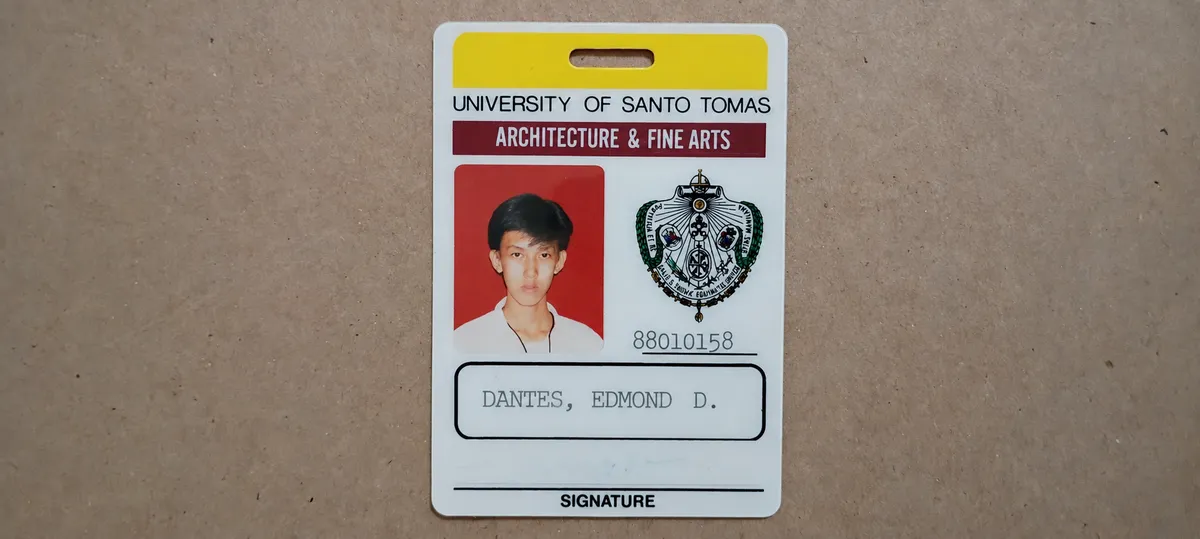
Age and prestige, however, do not automatically produce a sense of belonging.
I felt out of place almost immediately. My high school friends had scattered into their own lives, and suddenly I was surrounded by strangers. Some professors were wonderfully eccentric, a few were intimidating, and others crossed the line from demanding into outright bullying. Art materials were expensive, which was no small concern, and there always seemed to be another mandatory supply I had to track down.
Then came the truly alarming discovery that studying art did not mean simply sitting around drawing beautiful things. There was mathematics.
I cannot count. Perspective, proportion, measurement, dimensions—apparently civilization had conspired to insert numbers even into drawing. I had somehow imagined that the artistic temperament would exempt me from arithmetic. The artistic temperament had signed no such agreement.
I lasted one semester.
Dropping out felt like undeniable proof that I had no idea where my life was going. When you are young, a single semester can feel enormous, and a wrong turn can seem permanent simply because you have not lived long enough to know how many turns a life can contain.
Still, not everything about that semester was miserable. One of the few classes I genuinely enjoyed was History of Art, taught by Mrs. Samson. She was one of those teachers who could make the subject feel larger than a list of names, dates, periods, and movements. Art was something to look at, argue about, react to, and connect with things that seemed to have very little to do with museums.
One day, Mrs. Samson informed me that I looked very ancient Egyptian. She did not mean that I resembled a mummy. She said it was my profile—that there was something about it reminiscent of the famous bust of Nefertiti. I had no idea what a seventeen-year-old Filipino boy was supposed to do with the information that he possessed the profile of an Egyptian queen, but I took it as a compliment. I still do.
There is something rather fitting about remembering that remark from a professor of art history. She was teaching us to look at faces, forms, profiles, gestures, and images made thousands of years apart. Then one day she looked at me and saw ancient Egypt.
She also liked connecting art with ordinary culture, and eventually one of our classroom conversations wandered into dangerous territory: pop music. This was perilous for me because I was—and proudly remain—a devoted Madonna fan.
There was just one catch. It was 1988.
For a Madonna fan, 1988 was a strangely barren year. The enormous run of hits from Like a Virgin, True Blue, and Who’s That Girl was behind us, while Like a Prayer was still waiting in the wings for 1989. To me, this absence felt almost personally unjust. Madonna had spent several years being unavoidable, and suddenly I found myself in the uncomfortable position of having to maintain the faith while the rest of the world appeared to be moving on.
Then Mrs. Samson asked the question: “Is Madonna still hot?”
I said yes, obviously, and launched into an impassioned defense. I have long since forgotten my exact arguments, but I vividly remember the verdict: Mrs. Samson was unconvinced. So was the rest of the class. There I was, already struggling with perspective and proportion, worrying about expensive art materials, and wondering whether I had made a terrible mistake by entering Fine Arts, and now I was being required to defend Madonna’s cultural relevance before an unsympathetic academic tribunal.
But history has proven my position correct. I have been vindicated.
Looking back, what surprises me is not how much I remember from those months but how little. I cannot reconstruct most of my ordinary days at UST in 1988. What remains are fragments: unfamiliar classmates, strange rooms, professors I feared and professors I liked, Mrs. Samson seeing Nefertiti in my profile, and an afternoon spent defending Madonna before an unconvinced classroom.
Memory is peculiar that way. It does not preserve our lives evenly. Whole weeks disappear while a single sentence survives for decades. Events that seemed enormous at the time shrink almost to nothing, while some trivial classroom exchange becomes part of the permanent furniture of the mind. Perhaps that is why those few months seem both distant and strangely close to me now.
I thought I had failed when I left Fine Arts. At seventeen, I could not have imagined that decades later I would still be making images, studying them, thinking about how they communicate, and remembering with affection a professor who helped teach me how to look.
Sometimes the path we abandon is not a mistake. We may never have been meant to reach the destination at the end of it. Sometimes we only needed to travel far enough along the road to pick up something we would carry into the rest of our lives.
And, for the record, Mrs. Samson: to this day, people are still asking whether Madonna is hot.
A Mandela Effect. For years afterward, I carried a clear memory of a particular art book Mrs. Samson used in class. I couldn't describe every detail, but the impression remained: a large, illustrated volume covering centuries of painting and sculpture. Like many things from that semester, the book survived less as an exact object than as a presence.
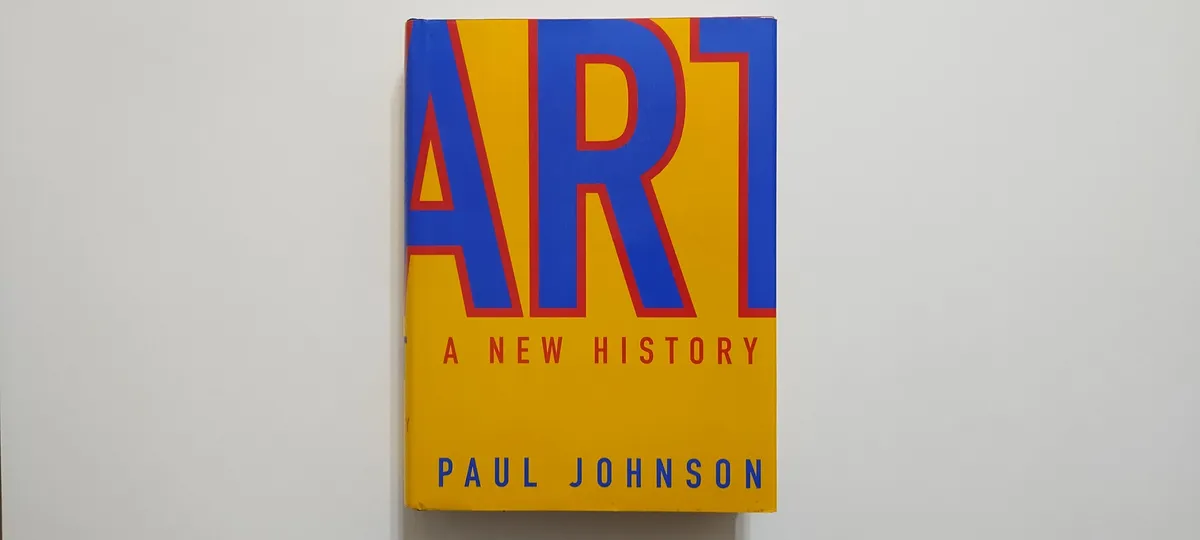
Much later, I came across Paul Johnson’s Art: A New History, and something about it felt familiar. The scale, the spacious pages, the generous reproductions, and the sweep from one period of art to another all corresponded to what I remembered from Mrs. Samson’s classroom. I was so certain of the connection that I eventually bought a second-hand copy.
When I realized that my copy was much newer than anything we could have used in 1988, I simply assumed Mrs. Samson must have had an earlier edition. But then I discovered there was no earlier edition for her to have had. Johnson’s book was published long after my brief career as a Fine Arts student at UST. Whatever book Mrs. Samson used in 1988, this was not it.
My memory had performed a small act of forgery.
What interests me is how convincing the forgery had become. I hadn’t consciously invented anything. There had been an art-history book in that classroom, and years later I encountered Johnson’s book. Somewhere in between, my mind joined the two. A general impression survived after the particulars faded, and when I encountered something that fit the memory’s shape, it quietly took the vacant place. Eventually, I became certain enough of that identification to buy the book.
That discovery seems less disappointing than strangely moving. We lose enormous portions of our lives without noticing, while a voice, a face, a classroom joke, or the atmosphere of a particular afternoon may remain with extraordinary force. The gaps do not always remain empty. Sometimes memory supplies connections of its own, not maliciously, but because the things belong together emotionally even when they do not belong together chronologically.
Looking at the book now, I can see why the mistake was easy to make. Its cover is almost impossible to ignore: a field of brilliant yellow broken by enormous blue letters outlined in red, with “Art” filling most of the jacket . . .
Inside, the design is quieter. The pages are generous and restrained, allowing the reproductions to dominate: Dürer beside the opening of a chapter on the Renaissance, Donatello's David standing almost alone against the page . . .
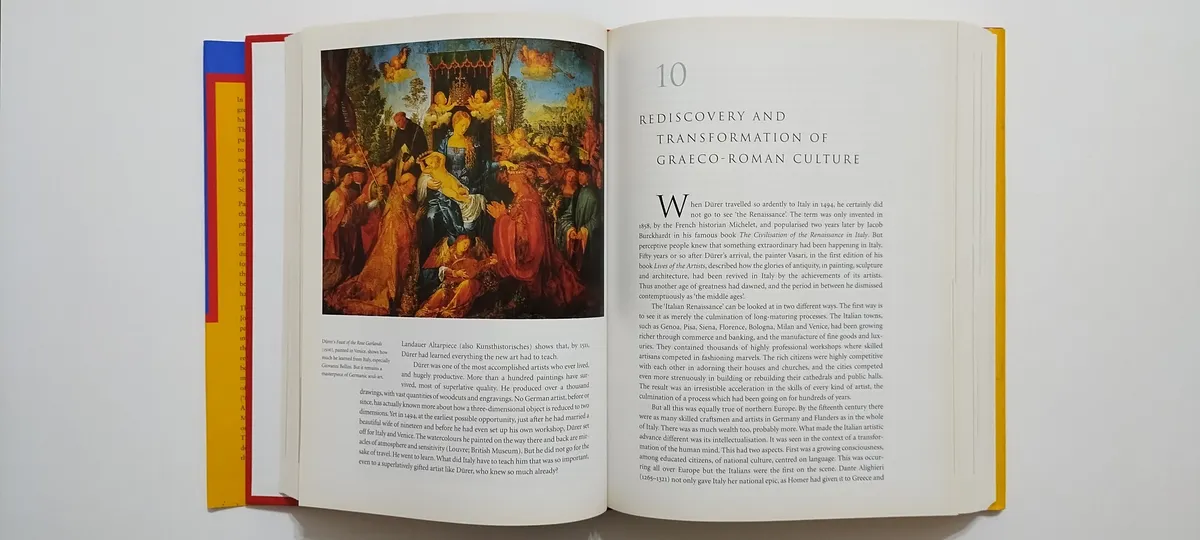
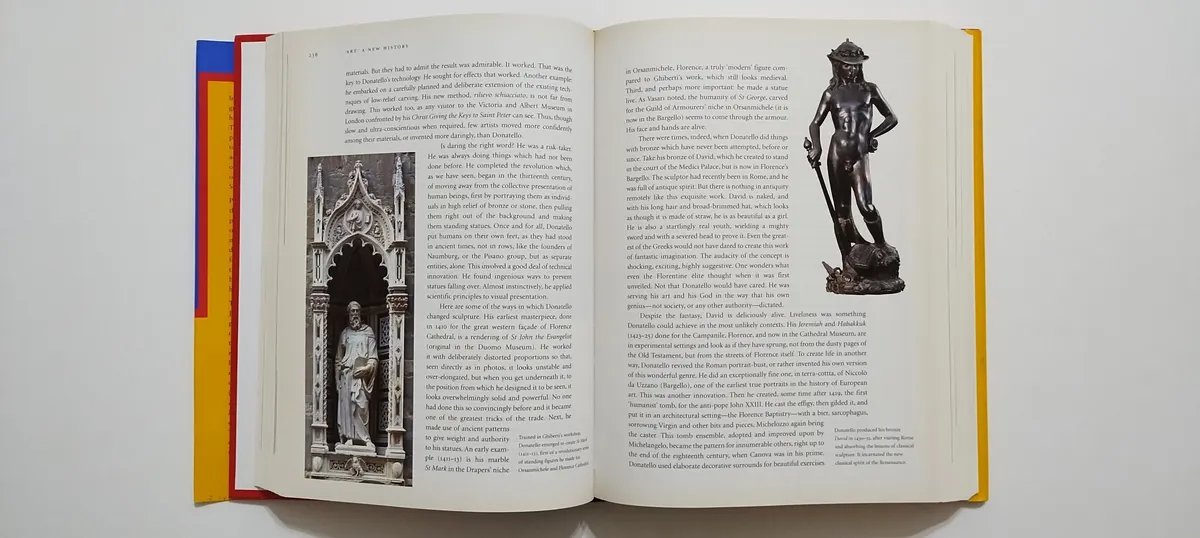
Caravaggio's Crucifixion of Saint Peter filling an entire page with darkness and violence, followed later by Rembrandt and Burne-Jones. The accompanying photographs show the book as I know it now—large, heavy, slightly worn at the edges, and meant to be opened flat and looked at slowly . . .
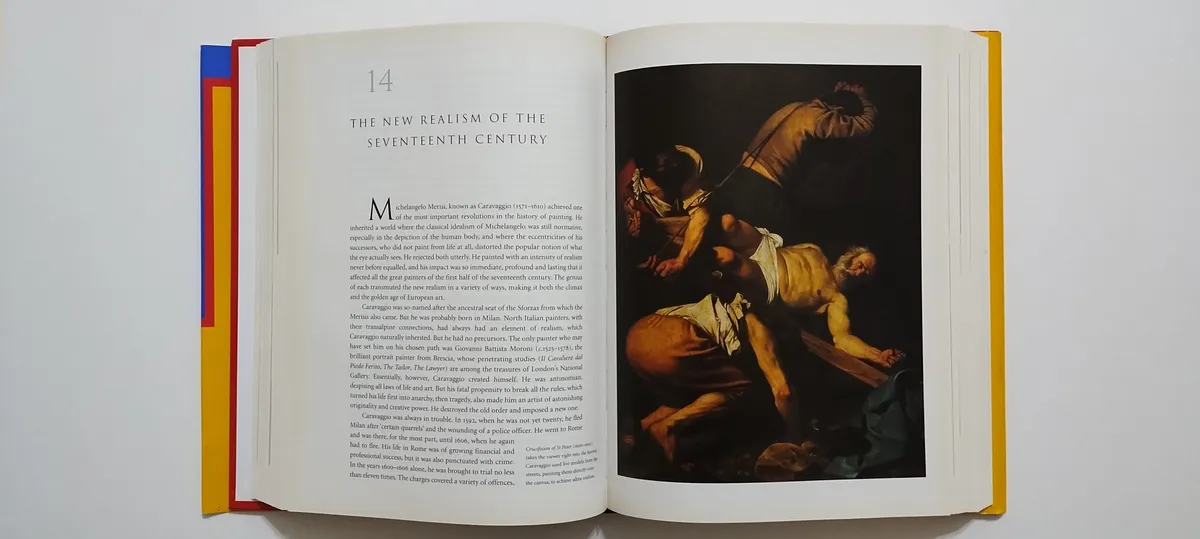
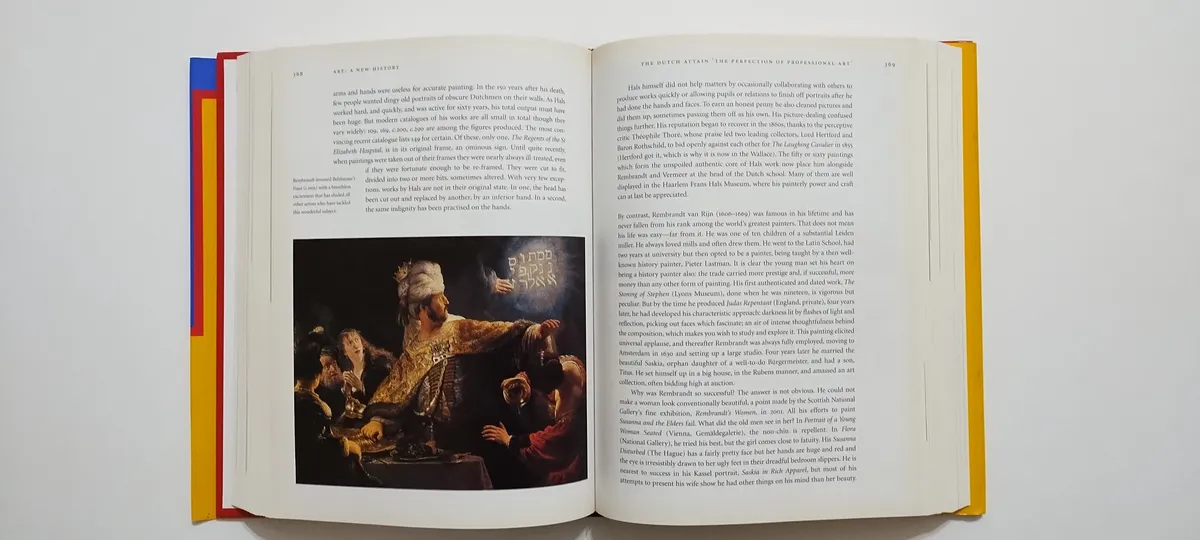
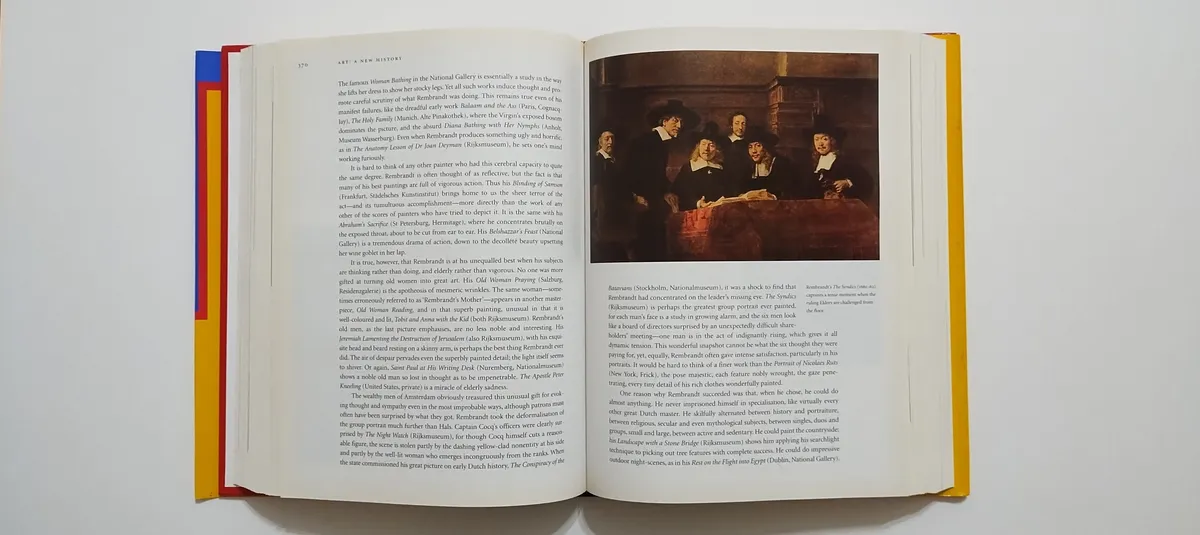
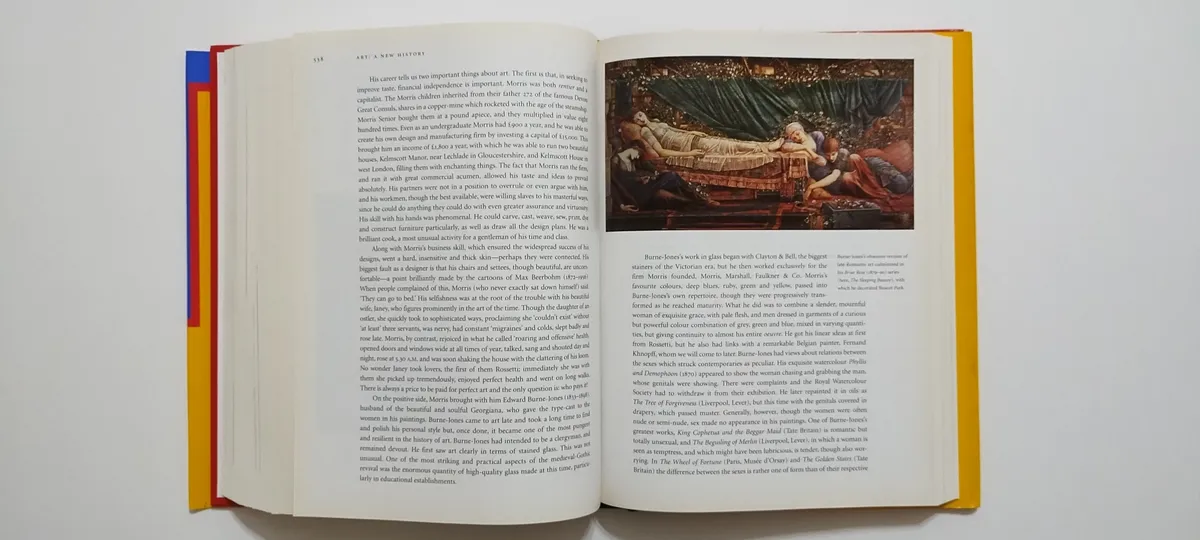
There is something almost mischievously appropriate about the philosophy printed on its back cover. Johnson argues that we must learn to look at art with our own eyes rather than allowing authorities to do all the seeing for us . . .
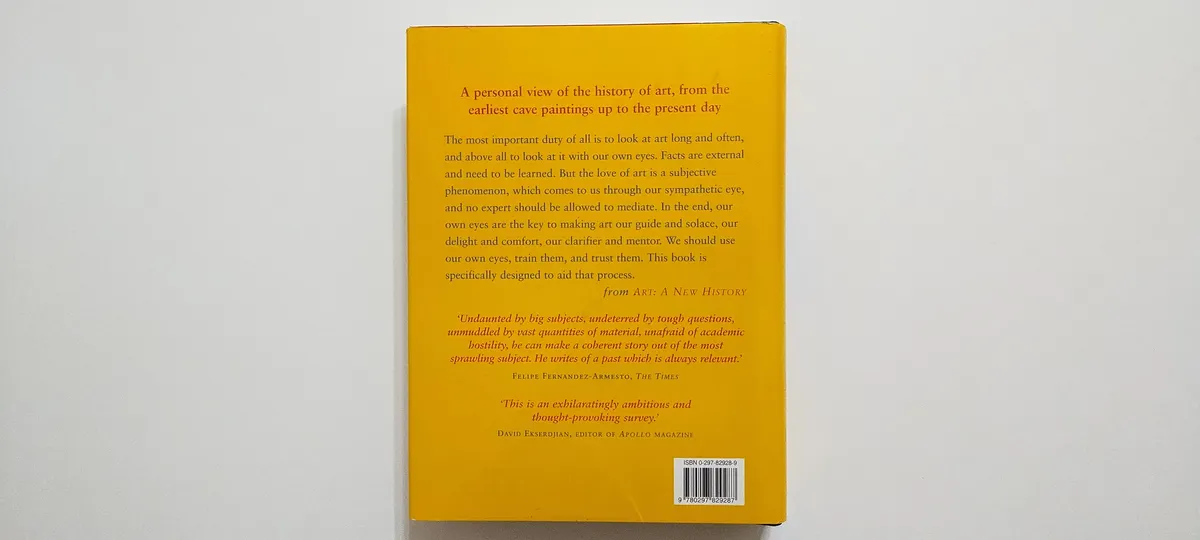
That idea could easily have belonged in Mrs. Samson’s classroom, even though this particular book never did.
So this is not the book she used in 1988. It is something stranger: the book I bought because I believed I remembered it. Because of that mistake, it has acquired a history of its own. It does not take me back to that classroom because it was there. It takes me back because, for many years, I was certain it had been.